
Written by Rytis & Violeta · Feeling Session founders · Updated May 2026
· 13 min read

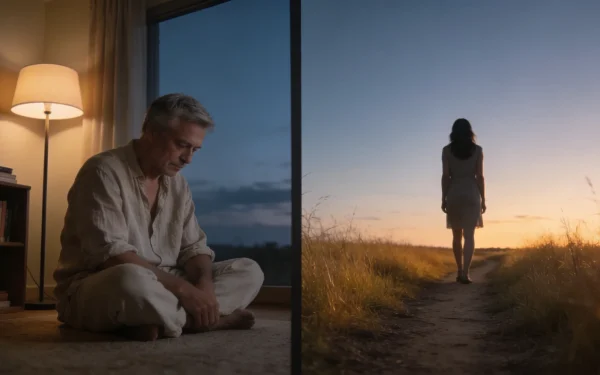
Your chest is tight right now. Maybe not dramatically — but there’s a weight sitting somewhere between your ribs and your throat that doesn’t match how much you already know about yourself. You searched for spiritual shadow work because something no longer adds up. You can name your patterns. You’re probably the steady one for everyone around you. But at 2 a.m., when the house goes quiet and your phone is face down, the tightness comes anyway. The racing mind comes anyway. The tools that once helped now feel thin, like a coat you’ve outgrown.
Healing is less about understanding yourself forever and more about not leaving yourself now.
If that’s where you are, the fog can clear more quickly than you’d expect. By the end of this guide, you’ll know exactly what to do tonight when the tightness returns — and why that one move starts to soften the cycle.
There’s no shame in this moment. It isn’t backsliding. It’s often the exact threshold where deeper work becomes possible.
Here’s the turn most people need: the path forward is usually clearer than it feels. And clarity begins when the next move is specific enough to do with your actual body, in this actual moment. Spiritual shadow work isn’t about finding better explanations for pain. It’s about staying close to what your body is already saying — long enough for truth to move from concept into lived experience.
If you want the wider map first, start with shadow work for beginners. This guide goes straight to the spiritual layer: why growth can start feeling performative, how real shadow integration unfolds, and what to do when your nervous system says “too much.”
Why spiritual shadow work usually starts when old strategies fail

Sometimes the beginning doesn’t feel like a beginning. It feels like everything stopped working at once.
Most people think shadow work begins when they choose it. In real life, it often begins when your old protection stops working.
You meditate, and the same trigger still lands.
You journal, and the same relationship loop repeats.
You understand your childhood, and your body still braces when someone pulls away.
That doesn’t mean you failed. It means you’re crossing from insight into embodiment.
In Jung’s framing, the shadow includes what you disown to stay loved, safe, or acceptable. Yes, that includes anger, jealousy, fear, and shame. But it also includes power, desire, directness, creativity, and clean boundaries. The shadow isn’t only what looks dark. Sometimes it’s the bright, alive part you were punished for showing.
If you want conceptual background, these two references are useful: Carl Jung and Shadow (psychology).
The spiritual tension here is subtle and real. Many of you learned practices that helped you rise above pain. But pain was never asking to be transcended. It was asking to be felt. So you called shutdown peace. You called suppression surrender. You called fear intuition.
That wasn’t weakness. It was intelligent protection.
What changes everything is simpler than you’d think: shadow work deepens when you stop arguing with your nervous system. The argument sounds like, “I shouldn’t still feel this.” Integration begins when that becomes, “This is here. I can stay.”
If the same themes keep returning, evidence suggests that’s often not a dead end. Under stress, old protective patterns reactivate quickly. That’s biology, not spiritual failure. The APA overview on stress explains the mechanism clearly.
Repetition is not proof that nothing changed. Often, it’s proof you can see the pattern sooner, abandon yourself less, and return faster.
The turning point most advice skips: sensation before story

Your body knew something was off long before you had words for it. It still does.
A lot of content on spiritual shadow work stays in the head. Prompts. Meaning-making. Labels. Some of that is useful. But when emotional charge lives in the body, head-only work can become elegant avoidance.
A more trustworthy question is: Where is this in my body right now?
If that feels hard to answer, you’re likely in narrative, not contact.
Your system detects threat and safety before your mind builds an explanation. So this work becomes real in ordinary moments: your throat closes after conflict, your stomach drops after a message, your chest hardens at bedtime. The shift begins when you stay with sensation instead of abandoning yourself for analysis.
That is meeting your shadow. Quietly. Without performance.
There’s a real trade-off here, and it matters to name it cleanly. If you stay with sensation, discomfort may rise before it settles. If you leave sensation, the moment may feel easier — but the same charge usually returns. Neither choice makes you good or bad. But if integration is the aim, temporary discomfort is often part of the path.
This is not a call to flood yourself. Real shadow integration is paced honesty: enough contact to process, not so much that your system goes offline. If you carry trauma history, move slowly and use qualified support.
One more thing worth saying: shadow work is not only about pain. Sometimes the exiled part is your joy, your voice, your ambition, your erotic aliveness, your refusal to disappear. I’ve seen people process grief for years while still feeling unsafe being fully alive.
The old question is, “How do I stay acceptable?”
The deeper question is, “What did I exile to survive — and can I welcome it back in honest, manageable doses?”
What shadow integration looks like in real life
It’s rarely the big revelation. It’s the Tuesday morning where something shifts and you almost miss it.
Integration sounds abstract until it shows up on a Tuesday.
The trigger still happens, but recovery is faster. You spiral less and return sooner. You need less explanation, less image-management, less spiritual theater.
You notice when you use wise language to hide fear. You apologize without collapsing. You stop calling every intense impulse “intuition.” You let mixed feelings coexist without demanding instant certainty.
In relationships, integration is often visible before it’s eloquent. A sentence like, “I feel abandoned and want to attack, so I need ten minutes to ground before I continue,” is shadow work in action. Awareness and behavior are finally in the same room.
At work, this may look like not overdelivering to outrun disapproval. In spiritual life, fewer practices and more honesty. In the body, less chronic bracing.
A useful Jungian lens here is emotionally charged patterns — often called complexes: old survival material that can take over quickly in present-day moments. Naming the pattern won’t dissolve it instantly, but it creates enough space to choose your next move.
What helps in the exact moment is learning to hold two layers at once. One layer is the felt experience: burning in the chest, pressure in the throat, numbness in the face, shaking energy in the belly. The other layer is the observing presence that says, “This is intense, and I’m still here.” That observer is not cold distance. It’s steady contact. You’re not trying to escape feeling. You’re staying with feeling without becoming only the feeling.
Depth usually appears in small waves. Anger can open into grief. Control can open into fear. Perfectionism can open into a younger part that learned love had conditions. This is why spiritual shadow work can feel surprisingly tender. Under the loud defense, there’s often a very human need that never had enough room.
When you practice this way, the middle of your day starts changing — not only your journal pages. You pause before sending the reactive text. You notice your jaw locking before the argument escalates. You feel the urge to perform calm, and choose honesty instead. These are quiet moments. But they’re where integration becomes real.
Where spiritual language can quietly block the work
This is where many thoughtful people get stuck.
You say “detachment” when you’re dissociating.
You say “discernment” when you’re avoiding intimacy.
You say “high standards” when you’re terrified of being seen in need.
Words are not the problem. Disconnection is.
The same confusion appears in ego-versus-intuition moments. A practical test: intuition is often quiet, steady, and body-grounded. Fear in spiritual clothing is often urgent, absolute, and physically contracting. Not always. But often enough to test before acting.
Journaling still helps, but sequence matters. If writing replaces feeling, it becomes sophisticated escape.
Feel first. Name what is there after contact. Let meaning come later, once your body is no longer in alarm.
When integration deepens, your story usually gets shorter.
Healing is less about understanding yourself forever and more about not leaving yourself now.
If your body is carrying more than your mind can hold right now, Name the pattern — 3 free answers, no credit card — You don’t need the perfect words. One honest sentence is enough to start.
A body-first practice for tonight
You don’t need to understand this perfectly. You just need twelve minutes and a floor.
If you take one thing from this article, take this practice. Not to force calm. Not to perform progress. Just to end self-abandonment for twelve honest minutes.
Give yourself permission to do it imperfectly.
The 12-minute “stay” practice
- Lie on your back in a quiet place.
- Place your hands beside your hips, palms down.
- Close your eyes and cover your eyes with a soft shirt or scarf.
- Keep your body still. No swaying, rocking, or repositioning unless you need to stop for safety.
- Ask: “Where is the heaviest point in my body right now?”
- Choose one location only (throat, chest, stomach, shoulders, hands, eyes, or whole-body heaviness).
- Set a 12-minute timer. Stay with raw sensation there: pressure, heat, numbness, ache, pulsing, tightness.
- When thoughts pull you into story, return to sensation. Again and again.
- If intensity rises above what you can tolerate, open your eyes, feel the surface beneath you, and shorten the session to 6 minutes.
- When the timer ends, sit up slowly. Ask: “What softened, even 2%?”
- Take one integration step: drink water, keep the next 20 minutes quiet, and reduce input.
One quiet truth: “Nothing happened” is still data. Numbness is not failure. Numbness is a protective state becoming visible.
If you want structured support with this same body-first approach, you can explore resources in the infeeling™ network for real-life emotional processing without forced positivity.
What changes after practice—and what stays true
The shift isn’t fireworks. It’s the moment you realize you didn’t abandon yourself this time.
What changes is your relationship with yourself. You trust direct experience more than your performance of healing.
What softens is speed and force. Shame loses momentum. Reactivity loses certainty. Difficult conversations stop feeling immediately catastrophic. Pain may still be present, but you no longer stack self-abandonment on top of it.
What stays true is simple and steady: sensation, breath, honesty, return. You will still get triggered sometimes. Progress in spiritual shadow work is not “never activated again.” It’s noticing sooner, staying gentler, and coming back more consistently.
So keep the path narrow enough to follow:
- Do the 12-minute practice tonight.
- Repeat it three times this week.
- Track one question: Did I stay with the body when activation appeared?
The clearest path is rarely dramatic. It’s the one you can actually do when your chest is tight, your mind is loud, and the old mask is asking to come back. Stay. That is where trust becomes real.
You don’t have to fight spiritual shadow work by force. You can meet it with honesty, gentleness, and one true next step.
What often changes early is not the whole story, but the amount of force inside it. When spiritual shadow work is named honestly, your body usually stops wasting so much energy on hiding, bracing, and pretending to be fine. That’s where clarity begins. You may notice a little less pressure in your chest. A little more room in your breathing. A little less panic around what this means about you. Those are not small things. They’re signs that truth is starting to replace performance.
And this is the line to keep close when the night gets loud: Healing is less about understanding yourself forever and more about not leaving yourself now. When that lands, you stop negotiating with your pain and start meeting it. Not perfectly. Not all at once. Just honestly, in your body, one real moment at a time.
You don’t have to fight spiritual shadow work by force. You can meet it with honesty, gentleness, and one true next step.
You don’t have to fight spiritual shadow work by force. You can meet it with honesty, gentleness, and one true next step.
When you’re ready, try Feeling.app free →
3 answers. 30 seconds each. No credit card. Yours to keep.
The Feeling Session is the body practice this work is built around.
Frequently Asked Questions
Why do we still feel this when we already understand our patterns?
Because your mind and your nervous system run on different timelines. You can explain a pattern with total clarity and still feel your body react from older learning. That gap isn’t a failure — it’s where the real work lives. Repeated, gentle body contact is what helps those layers reconnect. Understanding opens the door. Staying with sensation is what walks through it.
How do we tell intuition from fear dressed as intuition?
Notice the quality in your body. Intuition tends to be quieter, steadier — a knowing that doesn’t need to rush you. Fear in spiritual clothing usually feels urgent, rigid, and physically contracting in the chest, jaw, or belly. It demands you begin when you’re ready, decide now. When you’re unsure, pause. Come back to sensation first. The answer that stays after the urgency fades is usually the one to trust.
Can journaling still be part of spiritual shadow work?
Yes, absolutely. But order matters. Feel first — let your body have its say before your pen does. Then write briefly about sensation, impulse, and behavior. That sequence keeps journaling honest. When writing comes before feeling, it can quietly become a way to analyze your way around the thing instead of through it.
Why can shadow work feel worse before it feels better?
Because protective numbness can fade before integration settles in. When suppressed material starts becoming conscious, intensity may rise for a stretch. This doesn’t mean you’re doing it wrong. It means what was hidden is now visible. Short sessions, patient pacing, and consistency are safer than pushing hard through it.
How often should we do body-first shadow practice?
Short and regular almost always works better than intense and rare. Start with 10–12 minutes, three to five times a week. Consistency is what builds trust between you and your body. Over time, that trust makes progress visible in ways that marathon sessions rarely do.
How do we avoid retraumatizing ourselves during this work?
Use containment: one body area, one short session, one clear stop point. If you move outside your window of tolerance — if things feel too fast, too much, too far — pause and ground immediately. Feel the surface beneath you. Open your eyes. Shorten the session. If you carry trauma history, experience panic episodes, or notice dissociation, combine self-practice with qualified professional support. This work is meant to be paced, not forced.
What is spiritual shadow work?
Spiritual shadow work is a body-level experience, not just a thought pattern. It often shows up as chest tightness, shallow breathing, or a sense of heaviness — your nervous system responding to something it hasn’t fully processed. It is not a flaw. It is protection that outlived its purpose.
What causes spiritual shadow work?
The causes are rarely single events. Spiritual shadow work typically builds from accumulated stress, relational patterns, unprocessed grief, or early environments where certain feelings were not safe to express. The body adapts, then the adaptation becomes the pattern.
A note on this work: The Feeling Session is a body-first emotional practice — not therapy, not medical care, and not a substitute for either. If you are in distress, dealing with severe symptoms, or unsure what you need, please reach out to a licensed mental-health professional. The information here reflects our lived experience guiding sessions; it is offered as support, not as diagnosis or treatment.