
Written by Rytis & Violeta · Feeling Session founders · Updated May 2026
· 12 min read

If you searched for this, you’re probably not short on information. You’re short on something that holds when it actually matters. At 2am, when your chest gets tight and old fear starts running the show, polished spiritual language feels very far away from what’s happening in your body right now.
By the end of this guide, the fog should narrow into one next step you can use tonight — not just agree with in theory.
There is no failure here. You probably don’t need more insight first. You need one grounded way to meet what is happening in your body without force, performance, or spiritual self-judgment. If this moment feels familiar, you may also recognize the patterns in why do we feel empty inside and spiritual bypassing signs.
Here is the turn that changes the path: your shadow doesn’t soften because you explain it better. It softens when you stay with it directly, in sensation, long enough for protection to stop running the room.
That’s what I’ll walk you through here — clear, specific, and safe enough to use tonight.
“Your shadow is rarely the worst part of you.
It is often the most exiled part of you.”
Why this search appears when self-work stops working

Something worked for a while. Then it stopped. And you’re still here, searching.
This search usually shows up at a very precise point: you’ve done the work, but the same pattern still takes over when it matters most.
You read. You journal. You meditate. You understand your childhood pattern. Then one delayed reply, one critical tone, one silence — and your body reacts before your wisdom does.
That gap is the real pain. For many people trying this, this is the exact moment where confusion turns into discouragement.
From a Jungian frame, shadow material includes what you pushed out of awareness to preserve safety, belonging, or identity. If you want background, Shadow (psychology) and Carl Jung are solid starting points. But for beginners, theory is rarely the sticking point. The sticking point is this: you can name the pattern and still feel trapped inside it.
Relief begins when the question shifts from “Why am I like this?” to “Where is this in my body right now?”
That is where clarity starts.
If you want to go deeper, I unpack this in why self-work plateaus and what breaks through in my Shadow Work cluster.
What shadow work actually is (and what it is not)

It’s not another way to be hard on yourself. It really isn’t.
Shadow work is not self-attack dressed up as spirituality. It is not identity collecting. It is not proving how conscious you are.
Shadow work is an honest relationship with what you learned to hide. Sometimes that hidden part is rage, grief, fear, shame, envy, or need. Sometimes it is your voice, your desire, your joy, your direct no. You may have suppressed aliveness just as hard as you suppressed pain — and wondered why life feels flat. Done honestly, this experience is less about fixing yourself and more about staying present.
The beginner mistake is subtle: treating awareness as completion. Thinking “I see the pattern” means “I am free of the pattern.” Usually it means the work has finally become possible.
What I’ve found is that real shadow self awareness is lived, not performed. You notice the repeating pattern. You steady yourself enough to stay present in your body. You track sensation without adding story. From that contact, one different action becomes possible in real life — a clean boundary, a clear no, a repair text, or five minutes of silence before replying.
Most people stop after insight and call that integration. That’s why they feel informed but unchanged. The shift from understanding to meeting your shadow happens when the observer in you stays present with sensation instead of merging with the old script. If this is a core struggle, how to stop overthinking spiritually and spiritual ego signs can sharpen the difference. This is where shadow work for beginners becomes practical instead of theoretical.
If you want to go deeper, I map this in what shadow work is and what it is not in my Shadow Work cluster.
Try one prompt and stay with one body sensation until the timer ends.
The body-first entry point: where shadow integration begins

Your nervous system has been holding this longer than your mind has. Start there.
Here is the central truth of this guide: shadow integration starts in the nervous system, not in interpretation.
When you get triggered, meaning arrives fast.
“They don’t respect me.”
“I’m about to be abandoned.”
“I need to fix this now.”
Then the body follows: throat lock, chest pressure, gut drop, jaw tension, shallow breath, cold hands. That body moment is the hinge. Catch it, and choice returns. Miss it, and the oldest script speaks first.
A common fear is: “If I feel this fully, I’ll drown.” In my experience, what overwhelms people long-term is not feeling — it’s resisting feeling while acting from it. Structured contact, in small windows, builds capacity. Avoidance keeps the system brittle.
If you want broader mental health context on overwhelm and stress responses, the APA trauma resource hub is useful.
“Most reactions are not your deepest truth.
They are your oldest protection, speaking first.”
If you want to go deeper, I break this down in body-first shadow integration in my Shadow Work cluster.
How your shadow shows up in daily life
Not in dramatic breakdowns. In the quiet moments where you abandon yourself before anyone else can.
Shadow material usually arrives as repetition, not drama. It shows up in ordinary moments and familiar roles.
You over-explain to avoid disapproval. You freeze before setting a boundary. You call fear “intuition.” You call shutdown “peace.” You call people-pleasing “kindness.” You call emotional distance “maturity.” None of this means you are broken. These are protective strategies that once made sense. In daily life, this often starts by noticing these patterns without attacking yourself for having them.
In relationships, this can look like overgiving, testing, withdrawing, or staying vague while calling it discernment. At work, it can show up as perfectionism, procrastination, over-preparing, or carrying what was never yours. In spiritual spaces, it can look like fluent insight with very little body contact. If this feels close to home, ego vs intuition and feeling stuck after spiritual awakening often describe the same split in different language.
If you are known as the calm one, the wise one, the reliable one — your body usually sends the bill later. Through resentment, numbness, or bedtime dread. Your body tells the truth in patterns: same throat, same chest, same gut, same hour of night. Treat repetition as a doorway, not a flaw.
If you want to go deeper, see how shadow patterns show up in daily life in my Shadow Work cluster.
Why journaling alone can stall progress
Writing about the wound is not the same as being with it.
Journaling is valuable. It helps organize inner experience and gives language to what felt vague. Many people begin there for good reason.
The stall usually happens when writing becomes a substitute for contact. The sequence gets familiar: trigger, write, insight, temporary relief, repeat. The mind moves. The body stays braced. Then you assume the method failed, when the real issue is that the process never reached sensation long enough to update the system. This is why this needs direct body contact, not only reflection.
The strongest shift is usually smaller than you expect and more concrete than you expect: one sensation, one tolerable window, one grounded action. You name where the charge is. You stay with it without forcing. Then you do one repair in daily life while your body is still online.
That is how meeting your shadow becomes shadow integration.
If overthinking is part of your pattern, my guides on ego vs intuition and why meditation can make you feel worse can help.
If you want to go deeper, see why journaling stalls and how integration actually happens in my Shadow Work cluster.
A calm practice for tonight: one step you can trust
You don’t have to be ready. You just need something your body can lean into.
You don’t need to be calm before you begin.
You need a container your body can trust. For this, this kind of stillness gives your system a reliable place to start.
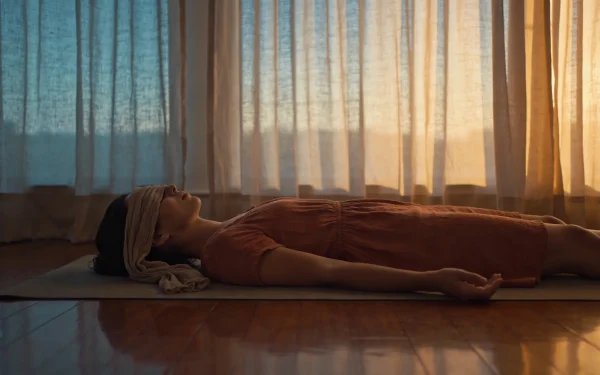
The 12-minute stillness session (beginner-safe, body-first)
Set a 12-minute timer when you won’t be interrupted.
- Lie down on a stable surface.
- Place your hands beside your hips, palms facing down.
- Close your eyes and cover them with a T-shirt or scarf.
- Let attention move from thought into sensation.
- Find one body location with the strongest charge: throat, chest, stomach, jaw, shoulders, or hands.
- Stay with that location only. No analysis. No interpretation. No fixing.
- Keep your body still — no swaying, rocking, stretching, or repositioning.
- If thoughts race, return to the exact physical sensation: pressure, heat, ache, numbness, hollowness, trembling.
- Track tolerance. If intensity rises too far, open your eyes, look around the room, name five visible objects, and pause.
- When the timer ends, write three lines:
– Where was the strongest sensation?
– What shifted, even 5%?
– What one real action will you take in the next 24 hours?
One quiet truth for this session: you are not trying to feel better on command. You are teaching your system that sensation can be met without abandonment.
If intensity goes beyond your window
If panic, dissociation, or overwhelm becomes too strong, stop and orient to the room. Pacing is skill, not failure. If you have significant trauma history or repeated destabilization, trauma-informed professional support is strongly recommended. For general mental health resources, see the NIMH resource hub.
“Don’t force a feeling to leave.
Stay long enough that it no longer has to shout.”
If your body is carrying more than your mind can hold right now, Name the pattern — 3 free answers, no credit card — If this reached something in you, there’s a next step that doesn’t require figuring anything out first.
If you want to go deeper, see the body-based beginner shadow practice in my Shadow Work cluster.
You can test up to 10 questions with full refund protection.
What changes after one honest session
Not everything. But something in you will be standing in a slightly different place.
The outer facts of your life may not change tonight. The hard conversation may still be ahead of you. The inbox may still be full. The relationship tension may still be real.
What changes early is your position inside the moment. Urgency loosens. Shame gets quieter. The reflex to abandon yourself just to end discomfort starts losing authority. You still feel the charge, but you are no longer fully fused with it. That’s the observer layer in real time.
From there, depth work becomes possible. You may notice one extra breath before reacting. A cleaner boundary sentence. Less compulsion to explain. More capacity to stay in your body while speaking truth. These are not small wins. They are clear signs that your system is beginning to trust your presence again.
So keep the next step simple and concrete: within 24 hours, do one 12-minute stillness session and take one matching action while your body is still clear. Send the honest text. Say the direct no. Ask for the repair. That is where this becomes real — one sensation, one honest minute, one lived choice.
You do not have to fight this by force. You can meet it with honesty, gentleness, and one true next step.
When you’re ready, try Feeling.app free →
3 answers. 30 seconds each. No credit card. Yours to keep.
The Feeling Session is the body practice this work is built around.
Frequently Asked Questions
Why do we repeat the same emotional pattern even after I understand it?
Because insight and integration live in different parts of you. Insight updates the story you tell about yourself. Integration updates what your body actually does when the pressure comes. Understanding a pattern gives you language — but repeated body-based contact is what loosens the automatic reaction itself.
How do I know if we’re meeting our shadow or just overthinking?
Notice what’s happening in your body. Overthinking pulls you further into story, urgency, and fragmentation — your chest tightens and nothing resolves. Meeting your shadow increases present-moment body contact. You feel more here, not less. And it usually leads to one clearer next action.
Can shadow work feel worse before it feels better?
Yes. As material you’ve pushed away starts entering awareness, discomfort can rise temporarily. This is normal. The stabilizing approach is pacing: short sessions, grounding between them, and support when you need it. Going slow is not weakness — it’s how you build real capacity.
Is journaling enough for shadow work for beginners?
Usually not by itself. Journaling supports recognition and gives shape to what felt vague. But lasting change generally requires somatic contact — actually being with the sensation in your body — plus one real-world step where the insight meets your life.
What if you feel numb and can’t find any sensation?
Start with what is available: pressure, temperature, hollowness, heaviness, or even the quality of “nothing.” Numbness is still a body signal — it’s not the absence of feeling, it’s a specific kind of holding. Consistent, patient contact often restores sensation in layers over time.
How often should beginners practice shadow work?
Consistency matters far more than intensity. Three short sessions per week is a strong starting rhythm, plus one weekly reflection and one small repair action so the work lands in your actual life.
Shadow work for beginners is not about becoming fearless. It’s about becoming honest enough to stay — long enough for your body to trust you again.
What is shadow work for beginners?
Shadow work for beginners is a body-level experience, not just a thought pattern. It often shows up as a racing heart, tense shoulders, or a persistent sense of unease — your nervous system responding to something it hasn’t fully processed. It is not a flaw. It is protection that outlived its purpose.
What causes shadow work for beginners?
The causes are rarely single events. Shadow work for beginners typically builds from accumulated stress, relational patterns, unprocessed grief, or early environments where certain feelings were not safe to express. The body adapts, then the adaptation becomes the pattern.
A note on this work: The Feeling Session is a body-first emotional practice — not therapy, not medical care, and not a substitute for either. If you are in distress, dealing with severe symptoms, or unsure what you need, please reach out to a licensed mental-health professional. The information here reflects our lived experience guiding sessions; it is offered as support, not as diagnosis or treatment.