
Written by Rytis & Violeta · Feeling Session founders · Updated May 2026
· 12 min read

You didn’t come looking for spiritual awakening signs because everything feels steady. Something is off. Your chest is tight. Your sleep is fractured. You’re functioning — but something underneath has shifted, and the words you’re finding online feel either too floaty or too clinical to match what’s actually happening inside you. By the end of this page, you’ll know what these signs usually mean, what to do with them, and one grounded step you can trust tonight.
Here is the early truth: what feels like breakdown is often the end of performance, not the end of you. Many spiritual awakening signs begin exactly this way. The version of you that could override your body, smile through pain, and call it “fine” starts to collapse. That can feel terrifying before it feels like relief. This page gives you honest signs, what they usually mean in the body, and one concrete thing to do before bed tonight.
The part of awakening nobody romanticizes

Sometimes the truest thing happening to you looks nothing like progress.
You were sold awakening as peace. Real life is often messier than that.
At first, you feel less certain, not more. Old conversations feel thin. Old coping stops working. Grief shows up without a neat story attached to it. You may even wonder if you’re going backward.
The confusion usually comes from one expectation: if this were real growth, it would feel peaceful. But early growth often feels like friction. The identity that kept you safe is cracking while your nervous system is still gripping it. That gap — between what’s falling apart and what hasn’t formed yet — can feel like anxiety, exhaustion, shame, and disorientation all in the same week.
A few anchors help when things feel noisy:
- What breaks first is usually the mask, not your core self.
- The body speaks before the mind agrees.
- Confusion is often a bridge, not a verdict.
Keep these close. They won’t remove the intensity. But they can stop the panic spiral. Many spiritual awakening signs are quiet at first — then obvious once you stop overriding what your body has been telling you all along.
12 real spiritual awakening signs nobody talks about

These aren’t glamorous. They live in your sternum at 2pm on a regular Tuesday.
This is not a diagnosis. It’s a grounded mirror for the stretch where growth feels unflattering, inconvenient, and very real.
1) You can’t fake “I’m fine” like before
You can still function. But pretending now costs you physically — jaw tightness, chest pressure, sudden waves of fatigue after social interactions.
That usually means less internal splitting. Your system is refusing to carry two realities at once.
2) Chest or throat pressure appears when the day goes quiet
Everything seems manageable until you stop moving. Then the tightness arrives.
Stillness reveals what busyness was covering. The sensation is rarely random. It’s delayed truth, finally surfacing because there’s room.
3) You cry without a clean reason
Tears come while driving. While folding laundry. While hearing one sentence that lands too hard.
This isn’t always collapse. Sometimes it’s thaw. The release often arrives well before the explanation catches up.
4) Performance-based relationships become hard to tolerate
Forced positivity, emotional guessing games, quiet self-abandonment — they start to feel unbearable in your body, not just your mind.
This can feel lonely before it feels honest. What used to feel like belonging may now feel like a betrayal of yourself.
5) Your old motivation system stops responding
The push that used to work no longer works. What once looked meaningful now feels hollow or strangely heavy.
Sometimes this is burnout and needs practical recovery. Sometimes it’s a values realignment. Often it’s both at once.
6) Noise and stimulation feel unusually intense
Crowds drain you faster. Back-to-back plans feel invasive. You need more silence than you used to.
This isn’t weakness. It can mean numbness is lifting — and your body is asking for cleaner, clearer boundaries around what it takes in.
7) Old pain returns even though you “already worked on it”
A wound resurfaces. Shame arrives alongside it: “Why am I back here?”
Healing is layered. What returns is often not repetition — it’s depth. A deeper layer of the same truth, ready now.
8) Spiritual practices feel worse before they help
Meditation brings anxiety. Journaling brings flooding. Practices that once soothed now expose.
This is common, especially after long stretches of using calm language to override pain. It connects closely with spiritual bypassing.
9) Sleep disruption spikes during intense periods
You wake at 2 a.m. Alert. Tense. Unable to settle.
Stress and sleep amplify each other (APA; CDC). During intense periods of awakening, identity friction and unresolved emotion can keep your whole system on alert — even when you’re exhausted.
10) You feel split between intuition and fear
You hear an inner voice. You can’t tell whether it’s guidance or panic.
A useful filter: fear is usually urgent, absolute, and tightening. Deeper knowing is quieter, steadier, and less dramatic — even when it asks something courageous of you.
11) You swing between numbness and emotional flooding
One day, flat. The next, everything is too much.
This pendulum often reflects capacity building, not failure. Your system is learning how much feeling it can hold safely. The swings narrow with time and honest contact.
12) You grieve lives you never lived
You grieve old versions of yourself. Missed years. Imagined futures that will never arrive.
Awakening includes loss. Something false falls away so something true can finally stand.
Not every sign points to awakening. Some overlap with trauma, depression, anxiety, and chronic stress. If symptoms are severe, persistent, or unsafe, add clinical support. Honest inner work and practical care can coexist — they often need each other.
Why this feels so intense
It’s not just the feeling. It’s what your mind is making the feeling mean.
The hardest part is often not the sensation itself. It’s the interpretation.
A sensation appears. Then the mind labels it as danger, failure, or proof that something is fundamentally broken in you. That second layer multiplies the suffering fast.
Several things tend to stack at once: identity destabilization, nervous system exposure, and meaning disruption. Old roles lose their charge. Old coping stops numbing. Old explanations stop convincing. This is why it can feel like a dark night of the soul.
The trap is a quiet one — a kind of spiritual perfectionism: If this were real growth, I would feel calm by now. That belief, left unchecked, becomes its own form of violence against yourself.
What helps is separating what is physically true from what fear is predicting. You might notice pressure in your chest, heat in your face, or a knot in your throat. Those are sensations. Then a thought lands: I’m failing again. I’m going backward. I should be past this. That is interpretation. When those two get fused together, suffering spikes quickly.
Try naming both parts in plain language: “Tight chest. Fast mind.” Nothing dramatic. Nothing polished. This small move gives your nervous system room. It reminds you that a sensation can be intense without being a personal verdict. Over time, that room becomes trust.
Another shift worth making: stop grading your inner life by how calm you look from the outside. A lot of spiritual awakening signs are invisible in public and loud in private. You may seem “fine” to everyone else while your body is carrying grief, fear, and unfinished stress underneath. That doesn’t mean you’re doing it wrong. It means your body is finally refusing to be edited for other people’s comfort.
A steadier view is simpler than you think: your signs are data, not verdicts. The work isn’t winning the argument in your head. The work is staying in honest contact with what your body is already saying.
If low mood, hopelessness, or shutdown is present, read depression and spiritual awakening and widen your support.
If your body is carrying more than your mind can hold right now, Write one true thing — 3 free answers, no sign-up needed — If you felt something shift while reading this, that’s not nothing. That’s your body recognizing something your mind has been circling.
A body-grounded reset for tonight
You don’t need a better theory right now. You need one doorway back into the body.
When your mind is looping, another insight won’t help. You need one safe, direct entry back into yourself.
Give yourself permission to do this imperfectly. You’re not trying to “do awakening right.” You’re practicing contact — honest, physical contact with what’s actually here.
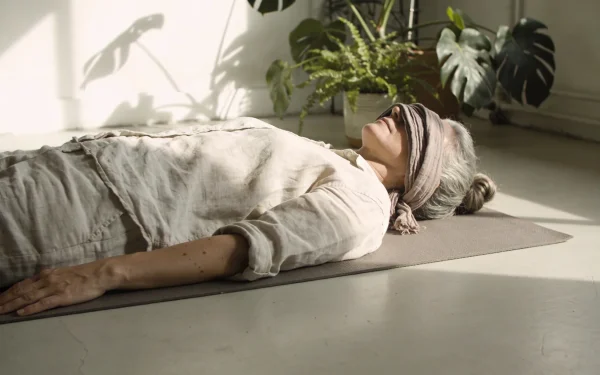
Use this 10-minute session exactly as written:
- Lie down on a flat surface.
- Place your hands beside your hips, palms facing down.
- Close your eyes, or cover them with a soft shirt or scarf.
- Keep your body still. No swaying, rocking, or repositioning unless needed for safety.
- Find the heaviest point in your body right now — chest, throat, stomach, shoulders, anywhere.
- Rest your attention on that exact point.
- Do not analyze. Do not force breath. Do not chase relief.
- If thoughts pull you into story, return to the sensation.
- Stay for 10 minutes.
Tolerance is the point, not intensity. If the feeling gets too strong, soften your focus to include the whole body for a few breaths, then return to the heaviest point.
One quiet truth to carry while you stay: a feeling is not an emergency just because it is uncomfortable.
After 10 minutes, sit up slowly. Drink water. Write one factual line:
“Right now, in my body, I notice ____.”
No philosophy. No fixing. Just what’s true.
Do this daily for 7 nights before judging whether it’s working.
What shifts after this practice starts landing
The outside of your life may look the same. But your shoulders know something has changed.
At first, nothing looks different from the outside. The inside changes first.
What changes: you stop treating every wave of feeling as proof that something is wrong. You recover faster after emotional spikes. You catch self-abandonment earlier — sometimes mid-sentence, sometimes mid-thought.
What softens: the night panic loops, the pressure to perform calm, and the reflex to explain away what your body is clearly saying.
What remains true: hard days still come. Grief still visits. Uncertainty still appears. But you stay with yourself through it instead of disappearing.
You may notice cleaner boundaries. Quieter mornings. A new ability to stay present during difficult conversations without leaving your own body. Some relationships deepen. Some loosen. What softens most is the war with yourself.
Do the 10-minute practice tonight. Write the one-line body truth. Then do it again tomorrow.
Clarity is rarely a lightning strike — it shows up when you stop abandoning yourself at the exact moment you most need your own presence.
What often changes first is not the whole picture, but the amount of force inside it. When spiritual awakening signs are named honestly — without drama, without shame — your body usually stops wasting so much energy on hiding, bracing, and pretending to be fine. That’s where clarity begins. You may notice a little less pressure in your chest. A little more room in your breathing. A little less panic around what all of this means about you. Those aren’t small things. They’re signs that truth is starting to replace performance. And when truth returns, you can choose what actually restores you instead of repeating what only keeps you depleted.
You don’t have to fight spiritual awakening signs by force. You can meet them with honesty, with gentleness, and with one true next step.
You don’t have to fight this by force. You can meet it with honesty, with gentleness, and with one true next step.
When you’re ready, try Feeling.app free →
3 answers. 30 seconds each. No credit card. Yours to keep.
The Feeling Session is the body practice this work is built around.
Frequently Asked Questions
Why do spiritual awakening signs feel worse at night?
Because night removes distraction. When the noise drops, what’s been living in your body all day gets louder. It can feel like things are getting worse. Most of the time, they’re just becoming more visible — finally allowed to surface because you stopped moving long enough to feel them.
Is crying for no reason a real awakening symptom?
It can be. The body often releases emotion before the mind has a story for it. Tears without a clear cause can be thawing, not breaking. That said — if crying is constant, severe, or comes alongside unsafe thoughts, please add professional mental health support. Both things can be true at once.
How can you tell intuition from anxiety during awakening?
Start with your body’s tone. Anxiety tends to feel urgent, tight, and catastrophic — like something terrible is about to happen right now. Intuition tends to feel steadier and quieter, even when the message it carries is hard. Give major decisions time. Come back to your body again and again. The truth usually doesn’t shout.
Why do people lose friends during spiritual transformation?
Because your tolerance changes. Dynamics that were built on performance, avoidance, or quiet self-abandonment become harder to sustain once you start feeling more honestly. The loss can hurt deeply. And it can also open space for connection that doesn’t require you to disappear.
Can awakening signs overlap with burnout or depression?
Yes. Fatigue, low motivation, heaviness, and disconnection can show up in all three. That’s exactly why sleep support, body-based regulation, and clinical care when needed all matter. You don’t have to choose between inner work and practical help — they belong together.
What is one thing to do today if you feel overwhelmed?
Do one 10-minute stillness session: lie down, palms down, eyes closed or covered, body still, attention on the strongest sensation you can find. One honest session done fully is more useful than another hour of turning it over in your mind.
What is spiritual awakening signs?
Spiritual awakening signs is a body-level experience, not just a thought pattern. It often shows up as numbness, disconnection, or an inability to name what you feel — your nervous system responding to something it hasn’t fully processed. It is not a flaw. It is protection that outlived its purpose.
What causes spiritual awakening signs?
The causes are rarely single events. Spiritual awakening signs typically builds from accumulated stress, relational patterns, unprocessed grief, or early environments where certain feelings were not safe to express. The body adapts, then the adaptation becomes the pattern.
A note on this work: The Feeling Session is a body-first emotional practice — not therapy, not medical care, and not a substitute for either. If you are in distress, dealing with severe symptoms, or unsure what you need, please reach out to a licensed mental-health professional. The information here reflects our lived experience guiding sessions; it is offered as support, not as diagnosis or treatment.