
Written by Rytis & Violeta · Feeling Session founders · Updated May 2026
· 13 min read

The lights go out. The house goes quiet. And suddenly — the anxiety that was manageable all day becomes unbearable. Your heart races. Your chest tightens. The worry you pushed aside at work, at dinner, during the commute — it’s all here now. Louder. Heavier. As if the darkness itself amplified it.
You’ve asked yourself a hundred times: this experience? As if understanding the mechanism would make it stop. As if one more explanation could finally let you sleep.
It won’t. Because the answer isn’t in your head. It’s in your body. And the body has been waiting all day for you to finally stop running and feel what it’s been holding.
If you’re reading this at 2 AM or 11 PM or 3 AM — whenever the nighttime anxiety hits — you’re in the right place. Not because something is broken. Because something is ready to be heard.
So this experience? The answer isn’t complicated. It’s somatic.
Why Is Anxiety Worse at Night? The Darkness Removes the Buffer

During the day, you have noise. Tasks. People. Screens. Distractions. All of it serving as a buffer between you and your feelings. The anxiety is there — it’s always there — but it gets crowded out by deadlines, conversations, emails, errands. Your mind has somewhere else to go. Your body has nowhere to put what it’s holding, so it waits.
At night, the buffer disappears. The distractions fall away. The silence arrives. And what’s left is exactly what your body has been carrying all day: the stress you didn’t process, the fear you didn’t feel, the worry you didn’t allow to move through. The anxiety isn’t worse at night because darkness causes it. The anxiety is worse at night because darkness reveals it. What was always there — held, pushed down, managed — finally has space to surface.
The mind creates stories. The body feels truth. And the truth your body is holding right now, in that tightness, in that racing heart, is simple: something has been pressed down. Something needs to be felt.
This is why is anxiety worse at night — not a mystery, not a malfunction. It’s the body’s most honest moment. When you finally understand this, you stop fighting the symptom and start listening to the source. When the world stops demanding your attention, the body finally gets yours. And it’s asking for what it’s been asking for all day: feel me.
What Your Body Has Been Holding

When you search why is anxiety worse at night, you’re usually looking for an explanation that will make it stop. A biological reason. A psychological one. Something you can fix. The truth is simpler: the nighttime anxiety isn’t random. It has a shape. A location. A quality. For some, it’s a tightness in the chest — the same feeling that visits during chest tightness anxiety during the day, only intensified when there’s nothing to distract from it. For others, it’s a churning in the belly. A pressure in the throat. A restlessness in the limbs. The body never lies. It always tells you the truth. And the truth is: you’ve been carrying something.
Maybe it’s worry about the future — bills, health, relationships, work. Worry that the mind turns into thoughts and the body holds as tension. Maybe it’s stress from the day that never got released. Maybe it’s grief from a loss you “handled” without letting yourself feel. Maybe it’s the accumulated weight of anxiety disorders — generalized anxiety, panic, social anxiety — that therapy has helped you name but not yet release. The mind turns these into thoughts. The body holds them as sensation. And at night, when the mind runs out of stories to tell, the sensation remains.
Caffeine, screen time, an irregular sleep routine — these can make nighttime anxiety worse. They’re not the cause. They’re amplifiers. People who wonder why is anxiety worse at night often blame these factors. And yes, cutting caffeine after noon, limiting screens before bed, and establishing a calming routine can help. But they address the conditions, not the cause. The real answer to this lives in the body. The real cause is the unfelt emotion that’s been waiting. The routine of your day — the busyness, the doing, the avoiding — keeps it at bay. Until it doesn’t.
The Practice: Feeling What Night Reveals
This is the most counterintuitive thing you’ll read: you don’t fight the nighttime anxiety. You feel it.
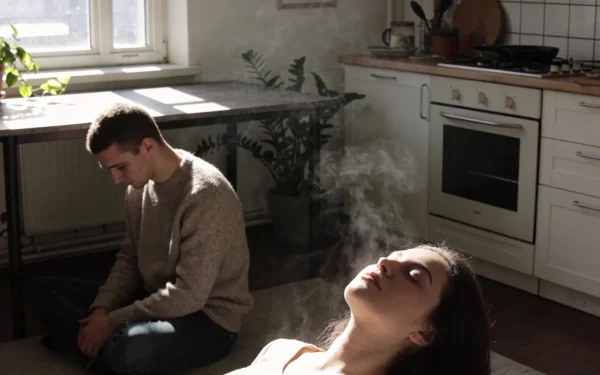
Lie down on the floor. A mat or blanket beneath you. Something soft over your eyes — a scarf or a soft T-shirt. Arms beside your body, palms facing down. Don’t move. Not a finger.
Now: feel the anxiety. Not as a problem to solve — as a sensation to be with. Where exactly is it? Chest? Belly? Throat? Jaw? What does it feel like? Pressure? Heaviness? Constriction? Warm or cold?
Don’t try to make it go away. Don’t try to breathe it away. Just feel it. Put all your attention there. Five minutes. Ten. However long the body needs.
If the sensation intensifies — that’s normal. The body is bringing what’s stored to the surface. Stay. Don’t move. Let it move through you.
Lying down is not laziness when you feel. That is enormous work.
One medicine for all situations — stop creating thoughts and direct your attention to the body and feeling exactly in this moment. That’s the entire practice. The anxiety isn’t the enemy. It’s the messenger. And the message is: feel what’s here.
When you feel the anxiety — really feel it, without fighting it — something shifts. Not always in the first session. But over time. The body learns that it’s safe to feel. The nervous system learns that it doesn’t need to run. The nighttime anxiety begins to soften — not because you forced it, but because you stopped resisting it.
What you resist, persists. What you accept — transforms.
If the anxiety is still sitting in your body right now, Write one true thing — 3 free answers, no sign-up needed — When something here made you pause, that pause is information. Your body knows more than your mind has caught up to.
Why Sleep Hygiene Isn’t Enough
You’ve probably tried the usual advice. No screens before bed. A consistent routine. Less caffeine. A dark room. A cool temperature. And maybe it helped a little. Maybe it didn’t. Because the sleep hygiene addresses the conditions of sleep — not the conditions of anxiety. The anxiety isn’t worse at night because your routine is wrong. It’s worse at night because the routine of your day was a buffer. Anyone who has asked this has likely been told to fix their sleep habits. And habits matter. But they don’t touch the root. The root is the unfelt emotion. The body holding what the mind has been too busy to feel. And when the buffer is gone, what remains is what was always there.
Therapy can help you understand the patterns. Medication can lower the volume. But the body is still holding something. The worry, the stress, the fear — they live in the body. They don’t live in the mind. The mind just reports them. And at night, when the mind runs out of stories to tell, the body speaks louder.
Thoughts come from emotions in the body. If you do something with thoughts but nothing with feelings in the body, you’ll never stop thoughts. The nighttime anxiety is the body’s way of saying: the thoughts aren’t the problem. The unfelt feeling is. Feel the feeling — and the thoughts, and the anxiety, begin to quiet.
The Connection to Racing Thoughts and Overthinking
When you ask why is anxiety worse at night, you’re often also asking why your mind won’t shut off. The two go together. When anxiety gets worse at night, it often comes with racing thoughts at night — the mind spinning through scenarios, rehearsals, replays. The same mechanism: the body holds emotion, the mind tries to “solve” it by thinking, and the thinking never resolves because the problem isn’t a thought. It’s a feeling.
For many people, the nighttime anxiety is the same as how to stop overthinking — the overthinking just happens in bed. The mind won’t shut off. The why do I overthink everything question lands at 2 AM when the world is quiet and the only thing left is the spiral. The solution isn’t the same for both: it’s the same practice. Lie down. Feel what’s in the body. Let the mind run if it must — but put your attention on the sensation. Over time, the body releases what it’s been holding. The racing thoughts slow. The anxiety softens. Because you felt what the thoughts were running from.
When anxiety meets emotional numbness — when you feel the restlessness but can’t access the emotion underneath — the practice shifts slightly. You feel the tension itself. The pressure. The constriction. Not as a block to get through, but as a sensation to be with. The numbness, when felt, begins to crack. And behind it, the feelings are there.
If you don’t feel now, you run from now. And the present is the only place where healing can happen. The invitation is simple: stop running. Be here. Feel what the night is revealing.
Beneath the Nighttime Anxiety — There You Are
And underneath all of that — beneath the anxiety, beneath the story about this, beneath the question you’ve asked yourself so many times — there’s a part of you that has never been touched by any of it. That’s the real you. The one who watches. The one who notices the tension and remains still.
Beneath all thoughts, beneath all feelings — there you are. A being of silence.
Your body — that’s your home. Come home.
The anxiety won’t lift all at once. It thaws in layers. Some nights you’ll feel more openness. Other nights, the tightness returns. That’s not failure. That’s the body testing: is it really safe? Can I really feel and survive?
Be gentle with yourself. You are learning. Every step is a lesson.
Your healing must come from within you. It is your relationship with your feelings. The nighttime anxiety is the body’s way of asking for that relationship. Not to be fixed. To be felt.
Living With Nighttime Anxiety
When the anxiety is a regular visitor at night — not a crisis, but a presence — it helps to have a practice. Not to control it. To honor it. When you stop asking this experience and start feeling what the night reveals, the relationship shifts. The anxiety becomes less of an enemy and more of a teacher.
Five minutes on the floor before bed. Eyes covered. Palms down. Feeling what the day left in your body. The stress. The worry. The unfelt emotion. Not to make it go away. To be with it.
Over time, the body learns that it’s safe to feel. The nighttime anxiety stops feeling like an emergency and starts feeling like a language. A way the body speaks when the world stops talking. You may still wonder this on difficult evenings. But you’ll know what to do: lie down, feel, stay. The answer isn’t in the mind. It’s in the body.
A consistent routine helps — but the routine that matters most is the one inside: the daily practice of lying down, feeling what’s stored, letting it move. That’s how the anxiety truly releases. Not by managing the symptom. By feeling the source. For people with anxiety disorders — generalized anxiety, panic disorder, social anxiety — the pattern of this experience can feel especially cruel. You’ve survived the day. You’re exhausted. And now the body demands what it’s been waiting for. The practice is the same. The body doesn’t discriminate between diagnoses. It just asks to be felt.
When you’re ready, try Feeling.app free →
3 answers. 30 seconds each. No credit card. Yours to keep.
The Feeling Session is the body practice this work is built around.
Frequently Asked Questions
Why is anxiety worse at night?
When people ask this, they often expect a simple answer. The answer is simple — but it’s not mental. Anxiety gets worse at night because darkness removes the distractions. During the day, tasks, people, and screens create a buffer between you and your feelings. At night, the buffer disappears — and what your body has been holding all day (stress, worry, fear, unfelt emotion) finally has space to surface. The anxiety isn’t caused by darkness; it’s revealed by it.
Why does anxiety spike in the evening?
The evening anxiety spike is another way of asking this experience. The answer is the same. The evening anxiety spike happens because the pace of the day slows. The demands drop. The distractions fade. And what was always there — held, pushed down, managed — finally has room to be felt. Your body has been carrying it all day. The evening is when it asks for your attention.
Can anxiety cause insomnia?
Yes. Nighttime anxiety and insomnia often feed each other. The anxiety keeps you awake — the racing thoughts, the physical tension, the worry that won’t quit. And the lack of sleep makes anxiety worse the next day. The solution isn’t just better sleep hygiene. It’s feeling what’s in the body before you lie down. Five minutes on the floor. Eyes covered. Palms down. Let the body release what it’s holding. Then go to bed.
Why do I get anxiety when I try to sleep?
When you try to sleep, you’re finally still. The mind has nothing to do. The body has nothing to distract it. And the unfelt emotion that’s been waiting all day surfaces. It doesn’t surface as feeling — it surfaces as anxiety: racing heart, tight chest, restless mind. The body is saying: feel me before you sleep. The practice is to feel it — not to fight it.
How do I calm anxiety at night?
In the moment: slow, deep breathing can help signal the nervous system that you’re safe. But for lasting relief, the practice is to feel what’s stored. Lie down before bed — five minutes, eyes covered, palms down, body still. Feel the anxiety in your body. Not as a problem to fix — as a sensation to be with. Over time, the body releases what it’s been holding. The muscle tension softens. The anxiety quiets.
Is nighttime anxiety worse than daytime anxiety?
This question gets at the heart of this. It’s not that nighttime anxiety is worse in intensity — it’s that it’s harder to avoid. During the day, you can distract yourself. At night, you can’t. The same anxiety that was there all day is now impossible to ignore. That’s why it feels worse. The feeling was always there. The darkness just revealed it.
Can caffeine make nighttime anxiety worse?
Yes. Caffeine can amplify anxiety — especially when consumed later in the day. It keeps the nervous system activated when the body needs to wind down. Cutting back on caffeine, especially after noon, can help. But caffeine isn’t the cause of nighttime anxiety. It’s an amplifier. The root cause is unfelt emotion in the body.
Does anxiety get worse at night for everyone?
Not everyone experiences worse anxiety at night. So if you’re someone who does, you might feel alone. You’re not. The pattern of this is common among people who carry stress or unfelt emotion during the day. But for many people who carry stress, worry, or unfelt emotion during the day, the pattern is common: the quieter the world becomes, the louder the body speaks. If you’re someone who feels fine during the day but struggles at night, the body is telling you something. It’s been holding something. And it wants to be felt.
Can therapy help with nighttime anxiety?
Yes. Therapy can help you understand the patterns and develop coping strategies. A good therapist can support the process — especially when you’re working through the deeper question of why is anxiety worse at night. But therapy alone often doesn’t address the somatic root: the body holding unfelt emotion. The combination of therapy (if needed) and body practice — lying down, feeling what’s in the chest, the belly, the throat — is often most effective. The body is where the anxiety lives. The body is where it releases.
Anxiety gets worse at night because darkness removes the distractions. What’s left is the feeling your body has been holding all day. Feel it.
Related reading: Racing Thoughts at Night | Chest Tightness Anxiety | How to Stop Overthinking | Why Do I Overthink Everything? | Emotional Numbness
A note on this work: The Feeling Session is a body-first emotional practice — not therapy, not medical care, and not a substitute for either. If you are in distress, dealing with severe symptoms, or unsure what you need, please reach out to a licensed mental-health professional. The information here reflects our lived experience guiding sessions; it is offered as support, not as diagnosis or treatment.