
Written by Rytis & Violeta · Feeling Session founders · Updated July 2026
· 11 min read
Somatic exercises to release emotions are paced body practices that help unclench what the mind already understands — the tight chest at 11 p.m., the numb hands after a hard talk, the flood that hits in the shower. You do not force a catharsis. You meet one sensation, at a dose you can stay with, until there is a little more room. Relief in the body is the measure.
You searched because you need something you can trust when your body is tight, numb, or flooded — not another idea that sounds wise and fails at night. If you understand your patterns but still feel stuck, that is not hypocrisy. It is a nervous system doing its job too well.
Here is the turning point: your body usually does not need a dramatic breakthrough. It needs a sequence it can tolerate. This page gives you that sequence — why some exercises backfire, how to work with activation and freeze without force, and what to do tonight in 10–12 minutes. Wider map first? Start with why the body still feels stuck when the mind understands, then return for the protocol.
Why your body still feels stuck when your mind understands

The crux is simple: insight and release are different jobs.
You can journal, reframe, meditate, set boundaries, and still feel your jaw lock at night. That does not mean those tools are useless. It means your body still detects threat, so protection outranks processing. In that state, “just feel your feelings” can land as pressure, and pressure reads as danger. Pacing matters more than intensity.
In The Door Home: A Book of Feelings, we put it this way: “Thoughts are like shadows on the wall. You have to go to the source itself – to where everything is coming from. And your body is the source – where everything comes from.” The mind can map the pattern. The braced tissue is where the work lands.
This is the hidden pain under this search: “Why do I know so much and still feel trapped?”
Most often, the answer is sequence—not effort.
Enough safety. Then enough sensation. Then integration.
When that order is respected, shifts tend to look ordinary but real: a deeper exhale, warmer hands, less armor in the throat, tears without panic, faster return after stress. That pattern is consistent with mainstream stress guidance from the APA. You can also pair this with a simple daily regulation rhythm.
The missing mechanism: how trapped emotion lives in the nervous system

“Trapped emotion” usually isn’t one emotional object waiting to explode. It is repeated micro-bracing that never got completion.
Your nervous system continuously scans for safety and threat. The vagus nerve helps regulate heart rate, digestion, and social engagement, and it influences whether your system can soften or stays defensive. For anatomy context, this vagus nerve overview is a useful starting point.
When protection dominates, people tend to land in three patterns:
- Fight/flight: urgency, racing thoughts, irritability, restless energy
- Freeze: numb, blank, disconnected, hard to initiate
- Mixed state: wired all day, collapsed at night
If freeze is your pattern, this matters: freeze is often high activation with blocked action, not laziness. Your system is mobilized but cannot complete the impulse, so tension remains stored as contraction. If this is your daily pattern, common freeze signs can help you recognize it faster.
This is why broad somatic advice often disappoints. It offers technique without state matching. High activation can flood in deep introspection. Shutdown can reject energizing practices as fake. Shame can turn any exercise into self-attack.
The practical pattern is clearer than it seems: match the practice to your current state, then increase capacity gradually. These exercises work best when they follow state, contact, and repetition.
We also use a simple image from the book: the body as a station. Feelings are trains that pull in and out. You give them space. You are the platform, not the train. Somatic release, in this sense, is not forcing the train to leave — it is stopping the habit of standing on the tracks and arguing with every arrival.
And for the spiritual angle without the fluff: home is not a mood you manufacture. As we write: “Home is always with you. Home is always inside you. And it always waits for you. The doors will never be closed.” The practice is returning — to chest, breath, this room — not ascending out of the body.
If this feels hard to hold alone, keep it simple and guided once.
A practical somatic release protocol you can do tonight

You are not forcing an emotional release. You are building conditions where release becomes possible. These steps are short on purpose, so your system can stay with them.
Before you begin: three safety notes
- If you have severe trauma symptoms, dissociation, or fast-escalating panic, use professional support when possible.
- Stop if you move outside your tolerance window (disorientation, terror spike, dizziness, loss of grounding).
- Intensity is not the goal. Presence is the goal.
Setup (2 minutes)
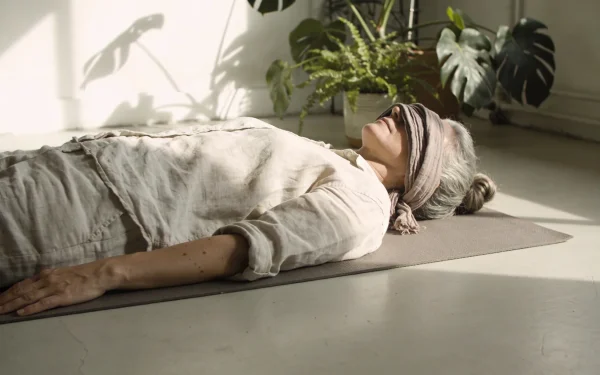
Lie down on a firm but comfortable surface.
- Hands beside your hips, palms facing down
- Body still (no swaying, rocking, stretching, or shaking)
- Eyes closed or gently covered
- Jaw unclenched
Say internally: Nothing to fix right now. Just contact.
Use this as a cue of safety before asking your body to feel anything. If you need extra support, add a brief grounding reset.
Exercise 1: State check, not story check (90 seconds)
Ask quietly:
- Am I mostly activated, mostly shut down, or mixed?
- Where is sensation strongest right now?
Answer with body language, not biography: tight throat, heavy sternum, buzzing forearms, hollow belly, heat in face.
Exercise 2: Longer exhale without performance (2 minutes)
If tolerable:
- Inhale through your nose for 4
- Exhale softly for 6
- No breath-holding
- Body still, palms down, eyes closed/covered
If counting creates strain, drop counting and simply lengthen the exhale a little. This aligns with broad relaxation guidance from NCCIH.
Exercise 3: One-point precision scan (3 minutes)
Choose one exact location of sensation.
Not “my chest.” More like: “left side of sternum, dense, warm, fist-sized.”
Track:
- Size
- Temperature
- Texture
- Movement or stillness
- Intensity (0–10)
Precision reduces fear. Vague dread becomes workable when it has shape.
Exercise 4: Contact and allow (3 minutes)
Keep attention on that one spot. Every 20–30 seconds, repeat one line:
- This is allowed.
- I can feel this and stay.
- No rush.
You may feel more intensity, less intensity, emotion, or almost nothing. All are valid. Your nervous system learns safety from what you can stay with, not from what you can force.
Exercise 5: Grounded completion (90 seconds)
Before ending, orient to present time:
- Feel the surface under your back
- Feel both palms pressing down
- Name five neutral facts (for example: “I’m in my room. It’s evening. The wall is white. My feet are warm. I hear a fan.”)
Then ask: What is 5% softer than 10 minutes ago?
Integration starts here. You are teaching your system to register change, not only crisis.
One-minute chest feel — from our book
If twelve minutes feels far tonight, start smaller. From The Door Home:
- Put the phone down. Close your eyes.
- Slow breath in. Slow breath out.
- For one minute, feel the chest — pressure, lightness, empty, cold, warm.
- Do nothing to it. Don’t soothe. Don’t improve.
- Open your eyes. Notice what shifted — even a little.
That is contact. Not a performance.
If you are in freeze response, use this variation
If everything feels far away, don’t force emotion.
- Same setup: lie down, palms down, eyes closed or covered, body still.
- Keep breath natural for 60 seconds.
- Start attention at feet and calves.
- Name sensation exactly: pressure, temperature, tingling, or numbness.
- Move slowly toward pelvis, belly, and chest only if tolerable.
- End with orientation and five neutral facts.
Patience is the mechanism. You are thawing, not pushing. If this pattern repeats, review how freeze response shows up in daily life.
If activation is high, use this variation
If your mind races and your body buzzes:
If your body is carrying more than your mind can hold right now, Name the pattern — 3 free answers, no credit card — You don’t need the perfect words. One honest sentence is enough to start.
- Same setup.
- Longer-exhale breathing for 2–3 minutes.
- Keep attention broad (whole torso) before narrowing to one point.
- Use intervals: 30 seconds on sensation, 15 seconds orienting to the room.
- Repeat 4–6 cycles.
This oscillation helps prevent flooding while building flexibility.
What to expect over two weeks
Practice 10–12 minutes daily, or during acute stress.
A common arc:
- Days 1–3: numbness, impatience, distraction
- Days 4–7: clearer sensation mapping, occasional emotion waves
- Days 8–14: faster recovery, fewer spirals, more agency
Progress in somatic work is usually not “never triggered.”
It is “triggered, then returning faster without abandoning yourself.”
Why somatic exercises sometimes feel worse first
Early discomfort does not always mean the method is wrong. It often means pacing was off.
The three common problems are predictable: too much sensation too fast, analysis replacing contact, and self-judgment during practice. Each one signals threat to the nervous system, so protection rises again.
A steadier approach is titration: small tolerable doses of sensation, repeated orientation to present-time safety, and no pressure to produce catharsis. Evidence suggests this pattern is more reliable for long-term nervous system regulation than intensity-first approaches. This is one reason the work can feel subtle at first but become more stable over time.
If you want more background, see our vagus nerve regulation primer and nervous system guide.
Red flags to pause and seek support
Pause self-practice and seek qualified care if you notice:
Persistent dissociation after sessions. Escalating panic or self-harm thoughts. Repeated flashbacks that do not settle. Worsening daily functioning or inability to return to baseline.
For broad public mental health support, NIMH resources are a practical starting point.
If you want steadier support between sessions, keep it gentle and consistent.
What changes when you stop forcing release
At first, the protocol can seem almost too simple: palms down, body still, eyes closed, feel one real sensation, orient back. But repetition changes the relationship.
What changes is your stance toward yourself: less fixing, more contact.
What softens is not only tension but mistrust.
What remains true is that hard emotions can still come—but they move differently when your body no longer expects to be overrun.
You stop treating numbness as failure.
You stop bargaining with your body for one dramatic breakthrough.
You start gathering evidence that you can feel and remain with yourself.
A calm move for tonight
Set a 12-minute timer. Do only this sequence once: setup, state check, longer exhale, one-point scan, grounded completion. No stacking tools.
Then write one sentence:
“The sensation I could stay with today was ______.”
That sentence turns effort into evidence. Evidence becomes trust. Trust makes tomorrow easier to begin.
What often changes early is not the whole story, but the amount of force inside it. When the sensation is named honestly, your body usually stops wasting so much energy on hiding, bracing, and pretending to be fine. That is where clarity begins. You may notice a little less pressure in your chest, a little more room in your breathing, or a little less panic around what this means about you. Those are not small things. They are signs that truth is starting to replace performance. And when truth returns, you can choose what actually restores you instead of repeating what only keeps you depleted.
You do not have to fight the body by force. Meet it with honesty, gentleness, and one true next step.
When you’re ready, try Feeling.app free →
3 answers. 30 seconds each. No credit card. Yours to keep.
The Feeling Session is the body practice this work is built around.
What People Notice When Feeling Returns
Before, I lived only in my head. The body was just the thing that carried my head around. After a few sessions I feel that I’m living. I feel my chest. I feel my belly. I can’t believe how much I had suppressed because of other people’s opinions.
— Laura
In this meditation Violeta’s voice was truly divine — so calm, calm… soft. It’s so good to stop everything, change nothing, not be responsible for the whole world — just watch what happens in the body, allow pain, allow joy. The body really is your home, always good to return to.
— Laimutė K.
Frequently Asked Questions
Why do I feel emotional after somatic exercises, even when I was numb before?
That is common. Numbness is often protective, not empty. When your system detects a little more safety, emotion can surface quickly. Keep sessions short and grounded so the opening stays tolerable.
How often should I do somatic exercises to release emotions?
For most people, 10–15 minutes once daily is more effective than occasional long sessions. Consistency usually supports nervous system regulation better than intensity.
Can somatic release help with freeze response?
Yes, especially with careful pacing. Freeze often responds better to gentle, precise body contact than high-intensity catharsis. Start with feet and legs, keep the body still, and build gradually.
Is crying necessary for trauma release?
No. Crying is one form of release, not the only one. Yawning, deeper breath, warmth, softer muscle tone, and clearer thinking can also indicate integration.
What if I can’t feel anything in my body?
Start with contact points: palms on the floor, back on the surface, air temperature on skin. “I feel nothing” is still valid data. Sensation often returns through steady repetition without force.
How do I know if I should stop and get professional support?
Pause and seek support if practice leads to persistent dissociation, escalating panic, self-harm thoughts, or worsening daily function. Somatic work should increase stability over time, not reduce it.
Your body is rarely asking for a perfect method. It is asking for one safe, specific step you can repeat.
What are somatic exercises to release emotions?
They are short, paced body practices — state check, longer exhale, one-point sensation contact, and a clear close — that help stored activation move without forcing catharsis. The goal is presence you can stay with, not intensity.
Why do emotions get stuck in the body?
Often from repeated micro-bracing that never completed — protection that outlived the moment. The mind may understand the story while the jaw, chest, or belly still holds the map. Sequence (safety → sensation → close) matters more than effort.
A note on this work: The Feeling Session is a body-first emotional practice — not therapy, not medical care, and not a substitute for either. If you are in distress, dealing with severe symptoms, or unsure what you need, please reach out to a licensed mental-health professional. The information here reflects our lived experience guiding sessions; it is offered as support, not as diagnosis or treatment. If you are in acute crisis, contact local emergency services (in Lithuania: 112) or a crisis line near you — this practice is not for unsupervised work in acute crisis.