
Written by Rytis & Violeta · Feeling Session founders · Updated May 2026
· 14 min read

You know the feeling. Your mind is quiet. You’ve done the reading, the meditating, the journaling. You can name your patterns with precision. And still — there’s that tightness in your chest when the room goes silent. That bracing in your belly you can’t think your way out of. You’re not here for another concept. You’re here because your body hasn’t caught up, and you’re tired of pretending it has. That doesn’t mean something is wrong with you. It means your system needs a different kind of attention.
This will get clearer as you read: what softens first is not your whole life, but the confusion about what to do when your body says “not safe.”
Here is the turn most people miss: this is not what you try after spirituality fails. It is what makes spirituality real in your body. When meditation brings anxiety, dread, or numbness, your practice isn’t broken. Your body is done pretending.
This is also why this experience can feel confronting at first. You’re no longer trying to think your way into safety. You’re learning to hear what your body has been telling you the whole time.
By the end of this article, you’ll have one precise practice you can do tonight. And you’ll know what to trust when your mind says one thing and your nervous system says another.
If you want the wider foundation, read the complete nervous system regulation guide, then come back here for the spiritual layer.
When Meditation Feels Worse, Contact Is Starting

Something real is being reached. That’s why it doesn’t feel comfortable yet.
The quiet shame sounds like this: “If I were truly growing, this would feel easier by now.”
That thought makes sense. It’s also incomplete.
When you sit still and feel more activation — not less — here’s what’s often happening: distraction drops, sensation rises. What was already living in your system becomes harder to outrun. Chest pressure gets louder. Heart rate climbs. Old fragments surface. You call it regression. Your body calls it contact.
Your nervous system doesn’t respond to spiritual vocabulary. It responds to cues of safety, threat, and connection. If it reads danger, it mobilizes or shuts down. In your actual lived experience, that can feel like urgency, scanning, numbness, heat, heaviness, or collapse.
This is why spiritual bypassing is so seductive. It offers meaning without embodiment. Interpretation without contact. If that pattern feels familiar, read spiritual bypassing signs.
The key discernment is simple: calm is not always regulation.
Regulated calm feels alive. You can feel your body and stay with emotion.
Freeze-based calm feels distant. You look composed, but you’re gone inside.
So the better question is not, “Am I calm?”
It is, “Am I here?”
In real this experience, “here” has a physical texture. You can locate sensation in your body without collapsing into it. You can track intensity without panicking about what it means. You can stay in contact for a few breaths longer than you could last week. That is already progress.
Most people skip this because it seems too simple. They want a dramatic release or a final answer. What actually works is quieter. You notice where sensation lives. You notice whether it’s sharp, dull, hot, cold, dense, or empty. You notice whether it stays in one place or spreads. This kind of body awareness is not a side detail. It is the ground floor. Without it, every spiritual insight stays in your head.
For anatomy context, the vagus nerve overview is useful. For stress-state context, fight-or-flight response gives a clear map.
The Hard Part Is Not Knowledge. It Is Trusting the Right Signal.

You already know a lot. The question is which voice inside you to believe.
Most people searching this topic aren’t missing theory. They’re missing trust in their own signal. Which inner voice do you follow when the messages conflict?
Try this in real time: after a strong inner message appears, watch your body for 10 seconds.
If a stress pattern is leading, there’s usually contraction plus urgency.
The message sounds sharp: “Now. Decide now.”
Breath shortens. Jaw tightens. Your world narrows.
If deeper intuition is leading, the message can still be firm — but the texture changes.
There’s space around it.
You stay grounded in your body.
You can pause without panic.
This isn’t a perfect formula. Trauma history can blur signals. Mixed states are common. But body evidence is often more trustworthy than mental argument.
In this experience, trust is built through repetition, not certainty. You gather evidence in small moments. You notice what happens after a decision, not just during it. Did your body soften over the next hour, or did it stay braced? Did your breathing widen, or did your chest stay locked? Did you feel more honest, or more defended? Over time, these patterns become very clear.
The same test applies to your spiritual routines. If a practice leaves you more detached, more self-critical, and less able to feel, it’s likely reinforcing protection. If it leaves you more available to grief, anger, tenderness, and repair, it’s likely supporting integration.
Freeze deserves special attention because it hides behind competence. You may keep working, replying, caretaking — even smiling. Inside, everything feels far away. If that lands, how freeze response can look like spiritual detachment may help you name it.
One clean pivot changes everything:
Stop asking, “What should I think?”
Ask, “What is happening in my body right now?”
That question interrupts performance and restores contact.
When this experience is working, you become less impressed by mental intensity and more interested in body truth. Big thoughts can still come. Fear can still come. Old stories can still flare. The difference is that you no longer confuse volume with truth. You check what’s happening in your system before you build a life decision around a spike of activation.
This is where the observer layer becomes practical. There is sensation: tight throat, clenched gut, pressure behind the eyes. There is protection: “I need to fix this now,” “I can’t let anyone see this,” “If I stop performing, I’ll fall apart.” And there is witness — the part of you that can notice both sensation and protection without attacking either one. That witness isn’t detached or cold. It’s steady contact. It allows depth without drowning.
For additional clinical grounding, the NIMH overview of post-traumatic stress disorder (PTSD) explains core stress mechanisms clearly.
You don’t need to sort this alone in the middle of a spiral.
Why Nervous System Regulation Is Spiritual Practice

The body is where every beautiful idea gets tested for truth.
The central tension in modern spirituality is this: many paths teach transcendence while your body is asking for contact.
If contact feels unsafe, higher-state language becomes a polished defense. It may look wise. It may sound evolved. The underlying rupture still stays untouched.
Regulation is not a detour from awakening. It is the doorway to embodied truth.
Presence is limited by nervous system capacity. If this moment feels dangerous, biology will override philosophy. That is why this experience matters: it closes the gap between what you believe and what you can actually live.
In practice, this gets concrete quickly. Instead of managing ten narratives, you return to one sensation: pressure in the throat, ache in the chest, heat in the face, numbness in the belly, buzzing in the hands.
That move is small. Its consequences are not.
The body is where your philosophy gets tested.
You do not become free by leaving your humanity. You become free by staying with it.
What usually worsens symptoms is familiar: overexplaining instead of feeling, chasing peak states, calling shutdown “peace,” and using meditation as suppression. What usually helps is simpler: lower the intensity, stay with one sensation, and let subtle shifts count.
If you need a gentler on-ramp, the somatic practice primer can help.
A lot of people hear this and think, “So do I have to feel everything all at once?” No. That’s the opposite of wise pacing. Good this experience is not emotional flooding. It is measured contact. You choose one sensation, one pocket of tension, one honest minute at a time. You build capacity the way you build trust with a person — slowly, consistently, without force.
This changes how you interpret difficult nights. If tears come, it doesn’t mean you’re going backward. If numbness comes, it doesn’t mean you’re blocked forever. If anger appears after years of people-pleasing calm, it doesn’t mean you became less spiritual. It can mean your system finally feels safe enough to stop hiding what was always there.
There’s also a deeper truth here that many people miss. When your body says “not safe,” your first practice is not transcendence. It’s honesty. Honesty might sound like: “My chest is tight.” “I am bracing.” “I feel far away.” “I want to run.” Those statements are simple. But they’re sacred in practice because they end self-abandonment in the moment it usually starts.
A living this makes your inner life less performative. You stop using beautiful language to avoid raw experience. You stop calling dissociation “detachment.” You stop calling fear “intuition” just because it’s loud. The result isn’t perfection. The result is integrity. Your body and your words start matching again.
If you need something steady right now, Name the pattern — 3 free answers, no credit card — If something in this article landed, your body is already pointing somewhere. You don’t need to have it figured out.
A 12-Minute Practice for Tonight (Permission, Not Performance)

You don’t have to get this right. You just have to stay.
Use this exactly as written once before sleep. Measure success by contact, not by feeling good.
Permission
You are allowed to meet tonight exactly as it is.
No breakthrough required.
No special state required.
Entry
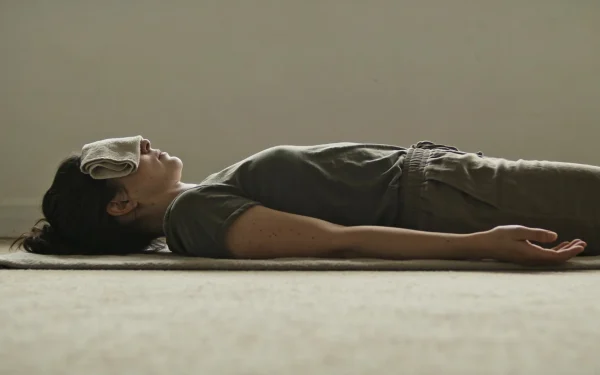
Lie on your back.
Place your hands beside your hips, palms facing down.
Close your eyes, or cover them.
Keep your body still.
Set a 12-minute timer.
Body location
Find the heaviest point right now.
Not the most meaningful.
The most physically obvious.
It may be pressure in the chest, a knot in the throat, weight in the stomach, or numbness anywhere.
Choose one place.
Tolerance
Stay with that one spot.
No analysis.
No fixing.
No story.
When attention drifts, return to the same location. Again and again.
If intensity rises above what you can stay with, open your eyes and orient to the room. Silently name five neutral objects. If your system settles, close your eyes and continue. If not, stop and do a shorter round tomorrow.
Capacity grows through pacing, not force.
One quiet truth
During the 12 minutes, look for subtle movement — not dramatic release.
The sensation may shift shape.
It may move location.
Your breath may deepen by 5%.
A sigh, a yawn, or tears may come without storyline.
Small movement is real movement.
Integration
When the timer ends, ask:
“What is true in my body now that was not true 12 minutes ago?”
Write one sentence.
Only one.
That sentence teaches your system to register change.
This is where many people underestimate the method. One sentence after contact turns experience into memory. Memory turns into trust. Trust turns into availability the next time you get triggered. That’s how this experience becomes part of daily life — instead of another nighttime emergency plan you forget by morning.
If you try this for seven nights, keep your notes short and concrete. Skip interpretation. Write what shifted in plain language: “Less pressure in chest.” “Jaw unclenched.” “Tears came, then warmth.” “Still anxious, but less scattered.” “Numbness stayed, but panic dropped.” These entries train your observer to detect real movement instead of chasing dramatic outcomes.
You’re not trying to become a different person in 12 minutes. You’re practicing not leaving yourself when sensation gets loud. Over time, that changes conflict, sleep, boundaries, and decision-making. It also changes your spiritual life. Prayer, silence, and meditation become less about escaping discomfort and more about staying in honest contact.
What Changes After You Practice This Way
At first it’s quiet. Then it’s undeniable.
At first, the shifts are quiet. Then they become undeniable.
What changes: you catch activation earlier. You recover faster after conflict. You stop mistaking numbness for peace. Decisions become cleaner because your body is back in the room.
What softens: the panic of “Which inner voice is true?” The pressure to perform calm. The shame that whispers you should be past this already.
What remains true, even on hard days: you don’t need to force transcendence to move forward. You need repeatable contact with what is here.
That is the real movement from confusion to confidence:
less debate, more sensation;
less performance, more presence;
less self-abandonment in the exact moment you need yourself most.
What often changes early is not the whole story, but the amount of force inside it. When this experience is named honestly, your body usually stops wasting so much energy on hiding, bracing, and pretending to be fine. That’s where clarity begins. You may notice a little less pressure in your chest. A little more room in your breathing. A little less panic around what this means about you. Those aren’t small things. They’re signs that truth is starting to replace performance. And when truth returns, you can choose what actually restores you instead of repeating what only keeps you depleted.
Over time, this becomes less of a rescue strategy and more of a way of living. You pause before reacting. You feel your feet before sending the text. You notice your throat tightening before saying yes when you mean no. You catch the moment your smile becomes armor. In those ordinary moments, nervous system regulation spiritual practice stops being an idea and becomes a lived orientation.
Hard days still happen. Old loops still return. The difference is that you recover without turning on yourself. You don’t need perfect regulation to have a real life. You need honest return. Again and again. That return is the practice.
You don’t have to fight your way through nervous system regulation spiritual practice — but you can meet it with honesty, gentleness, and one true next move. In lived nervous system regulation spiritual practice, that next move is almost always simple: feel what is here, stay with it for one more breath, and let your body teach you what safety feels like from the inside.
When you’re ready, try Feeling.app free →
3 answers. 30 seconds each. No credit card. Yours to keep.
The Feeling Session is the body practice this work is built around.
Frequently Asked Questions
Why do I feel worse when I meditate instead of better?
Stillness removes distraction. When distraction drops, unfinished stress responses come forward. Feeling worse often means your system is finally surfacing what was already there — not that you’re doing something wrong.
Can nervous system regulation really be a spiritual practice?
Yes. If spiritual practice is about truth and presence, then regulation is foundational. Your body needs enough safety to stay present. Without that, deeper presence becomes very hard to sustain.
How do I know if I’m in freeze response or actually calm?
Freeze tends to feel flat, distant, and hard to access from inside — like you’re watching yourself from behind glass. Regulated calm feels connected and alive. Emotion can still be present, but you remain here with it. You can feel your body.
Is somatic release supposed to be intense?
Not necessarily. Often it’s subtle: a sigh, softer breathing, warmth moving through you, tears without a storyline, or a small drop in tension you almost miss. Repeated subtle shifts usually build more lasting change than dramatic catharsis.
Where does the vagus nerve fit into this?
The vagus nerve supports parasympathetic restoration and connection states. In practice, the goal isn’t to force calm — it’s to create safe, repeatable conditions where your system can settle on its own.
How long until this starts helping?
Some people notice small shifts within days when the practice is gentle and consistent. Deeper changes tend to build over weeks and months of steady contact. Pace matters more than intensity.
If tonight is loud inside, skip the debate and do the 12 minutes. Clarity often returns the moment you stop leaving your body when it’s asking you to stay.
What is nervous system regulation spiritual practice?
Nervous system regulation spiritual practice is a body-level experience, not just a thought pattern. It often shows up as numbness, disconnection, or an inability to name what you feel — your nervous system responding to something it hasn’t fully processed. It is not a flaw. It is protection that outlived its purpose.
What causes nervous system regulation spiritual practice?
The causes are rarely single events. Nervous system regulation spiritual practice typically builds from accumulated stress, relational patterns, unprocessed grief, or early environments where certain feelings were not safe to express. The body adapts, then the adaptation becomes the pattern.
A note on this work: The Feeling Session is a body-first emotional practice — not therapy, not medical care, and not a substitute for either. If you are in distress, dealing with severe symptoms, or unsure what you need, please reach out to a licensed mental-health professional. The information here reflects our lived experience guiding sessions; it is offered as support, not as diagnosis or treatment.