Written by Rytis & Violeta · Feeling Session founders · Updated May 2026
· 12 min read

Your chest is tight. Your energy is flat. You are reading this late, probably, because nothing you have tried today made the ache quieter. At this point, this experience is not something you are researching out of curiosity. It feels like a question you have to answer correctly while already running on nothing.
This is not proof something is wrong with you. It is a sign your body and inner life have been carrying too much alone.
You are not broken—you are carrying more pain than your body can process alone.
When motivation disappears and the things that used to ground you feel hollow, confusion gets loud. You keep circling: “Is this a mental health condition, a spiritual collapse, or both?” That friction is real. Before you leave this page, the noise should be lower. You will know what to do tonight, and what to do next if this keeps building.
There is no shame in not knowing which frame fits. From the inside, these experiences can feel almost identical. The turning point is quieter than you might expect: stop trying to pick the perfect label first, and start with the next clear step. Clarity usually arrives through sequence, not certainty.
What I want to do here is practical. I will separate what matters, name where overlap creates confusion, and give you one body-based step you can take tonight to reduce noise and choose support with more confidence.
The distinction that changes your next move

Sometimes the most honest thing is admitting you do not know yet — and letting that be enough for now.
The crux is this: clinical depression requires clinical assessment; spiritual depression usually points to collapse in meaning, identity, or direction. These can co-exist.
Clinical depression often includes persistent low mood or loss of interest, with meaningful impact on sleep, appetite, energy, concentration, and daily function. If you want a baseline from established medical sources, use NIMH and the American Psychiatric Association.
What many people call spiritual depression sounds different in tone. “My old life no longer feels true.” “My practices feel hollow.” “I cannot find myself in what used to guide me.” You may still function outwardly. Inside can feel vacant, disoriented, and uninhabited.
The mistake that delays relief is forcing this into an either/or frame.
You can be in spiritual crisis and still need treatment.
You can be in depressive illness and still need existential integration.
Both can be true at the same time.
If you are in acute danger, triage comes first:
- If you are in the U.S. and having thoughts of self-harm, call or text 988.
- If you are outside the U.S., contact your local emergency number or crisis line now.
- If you cannot keep yourself safe, go to the nearest emergency department.
This is not alarmism. This is the order that protects you.
Why the overlap creates so much doubt

Doubt is not a sign you are confused beyond repair. It is a sign both layers may be real.
The overlap is not small. Both states can include numbness, fatigue, hopelessness, social withdrawal, and inability to feel joy. Both can make meditation harder. Both can make daily life feel like performance.
From the outside, they often look the same.
Inside the body, the drivers may be different.
With clinical depression, there is more often a broad, persistent flattening across contexts. With spiritual crisis, pain tends to spike around identity, meaning, value rupture, and disorientation — especially after loss, burnout, disillusionment, or intense inner work. You may keep meeting responsibilities while privately feeling disconnected from your own life. This is exactly why this experience can feel impossible to separate in the moment.
One useful depth check: notice the difference between sensation and interpretation. Sensation is “pressure in chest, heavy throat, cold belly.” Interpretation is “I am failing,” “I am broken,” “I should be past this.” The observer in you can learn to see both without collapsing into either.
This is why one okay day proves very little. And one difficult week proves very little. Panic reads moments. Wise decisions read patterns.
For the next 7–14 days, track five signals:
Pattern over time: steady decline, or wave-like shifts tied to existential triggers?. Function: are basic tasks (hygiene, meals, work, communication) getting consistently harder?. Body state: shutdown, agitation, or cycling between both?. Thought tone: “nothing matters at all” versus “my old meaning system no longer fits”?. Risk markers: self-harm thoughts, inability to care for yourself, escalating danger?.
Language like dark night of the soul or spiritual emergency can reduce shame and help you feel less alone. It should not replace risk assessment.
A line worth keeping close:
When pain becomes identity, every path looks wrong. When pain becomes information, the next step appears.
Built by two people who have lived through burnout, anxiety, emotional flooding, and the long road back to feeling safe in their own body.
Built by two people who have lived through burnout, anxiety, emotional flooding, and the long road back to feeling safe in their own body.
The trade-off that quietly keeps people stuck
Pause here. Find a place where you can be still for two minutes. Lie down if you can, or sit with both feet flat on the floor. Let your hands rest beside your body, palms facing down. Close your eyes or cover them gently with your hands. Breathe. Don’t try to change anything. Notice where in your body you feel what you just read. Chest? Throat? Stomach? Shoulders? Stay with that place. Not the thought about it — the sensation itself. Thirty seconds. That’s enough. That contact is already the practice.
The hardest part is not choosing between two explanations. It is holding both without abandoning either.
If you hold only a spiritual frame, you may delay care your nervous system urgently needs. If you hold only a clinical frame, symptoms may stabilize while the deeper rupture in meaning remains unresolved.
This is why one-note advice often fails people who are already doing the work. And why this experience needs a both/and lens in many real cases.
Some people are told to meditate harder. Then they feel worse and assume they failed. Some begin treatment, improve enough to function, then still feel spiritually empty and confused. That is not contradiction. It is incomplete care.
A more accurate framework is layered:
- Stabilize safety and physiology first (sleep, nourishment, clinical evaluation when indicated).
- Process meaning and identity next (grief, disillusionment, value realignment, integration).
- Run both tracks together when needed (clinical support and spiritual integration are complementary, not competing).
If you want a deeper view of that overlap, read depression and spiritual awakening.
One more layer matters: performance. In spiritual spaces, people can perform peace while the body stays frozen. In clinical spaces, people can perform compliance while existential truth stays unnamed. In both cases, you can look better while feeling less real.
So here is the simplest honesty check:
Can you feel one clear body sensation right now, without trying to fix it?
If not, that is not failure. That is your starting point.
If your body is carrying more than your mind can hold right now, Write one true thing — 3 free answers, no sign-up needed — When something here made you pause, that pause is information. Your body knows more than your mind has caught up to.
What to do tonight when you cannot tell which it is
You do not have to solve everything. You just need one honest contact point with your own body.
This is not a self-diagnosis tool. It is a clarity tool.
The goal is to reduce interpretation overload so you can choose your next step from grounded data, not panic. You do not need to solve your life tonight. You need one honest contact point with your body. This is especially useful when this feels tangled and urgent.
10-minute body check (exactly as written)
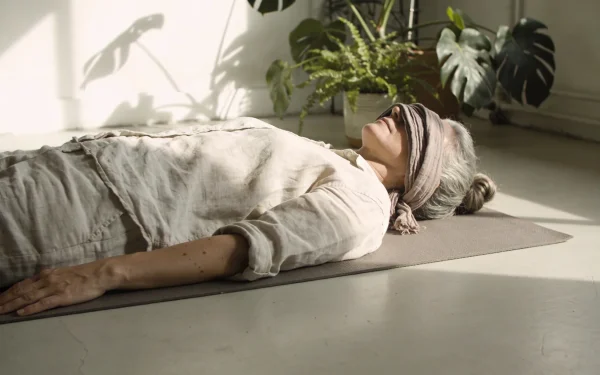
- Lie on your back. Place your hands beside your hips, palms facing down.
- Close your eyes and cover them with a soft shirt or scarf.
- Keep your body still. No rocking, swaying, stretching, or repositioning unless needed for pain or safety.
- Ask quietly: “Where is the heaviest point in my body right now?”
- Put attention there. No analysis. No fixing. No spiritual story.
- If your mind pulls away, return to raw sensation (pressure, heat, ache, tightness, numbness).
- Stay for 8–12 minutes.
- Write three lines only:
– “The strongest sensation was…”
– “Intensity (0–10) was…”
– “After 10 minutes, it shifted by…”
That is enough to begin.
This practice works because confusion spikes when thinking outruns regulation. Stillness and sensation tracking bring your signal back online. Fear may still be present, but your body gives cleaner information than midnight overanalysis.
Use your notes across seven days:
- If intensity stays high and function keeps dropping, treat this as a clinical priority and seek assessment quickly.
- If sensation reliably shifts with body contact and meaning themes become clearer, a spiritual crisis layer may be active and need integration support.
- If risk rises at any point, skip interpretation and move to immediate care.
What changed, what softened, what remains true
Even a small shift in how you relate to your own body changes what becomes possible next.
After one honest session, your whole life may not look different. But your relationship to this moment often does.
What changed: you moved from guessing to data. You now have a concrete signal from your body, not just looping thought.
What softened: shame, noise, and helplessness usually ease when you stop fighting sensation and start tracking it.
What remains true: you may still need professional care, and you may still be in a real spiritual rupture. Complexity is still real. Now you are meeting it from steadier ground.
Built by two people who have lived through burnout, anxiety, emotional flooding, and the long road back to feeling safe in their own body.
Built by two people who have lived through burnout, anxiety, emotional flooding, and the long road back to feeling safe in their own body.
How to choose support without abandoning yourself
The right support does not ask you to choose between your body and your inner life. It holds both.
You are not choosing a label for your identity. You are choosing the right support stack for this season of your life.
If safety is compromised, or depressive symptoms are persistent with functional decline, begin with clinical evaluation. That is not less spiritual. It is responsible care.
If your core rupture is existential and you are stable, add body-grounded spiritual integration.
If both are present, treat both now.
When evaluating any practitioner, ask:
- “How do you differentiate depressive illness from spiritual crisis in real practice?”
- “What is your protocol if risk escalates?”
- “How do you work with body-based awareness, not only thoughts?”
If answers are vague, keep looking.
Terms like “soul collapse” and “dark night recovery” can validate real pain. They can also be used to sell certainty. Be cautious with anyone who guarantees timelines, promises awakening outcomes, or discourages medical assessment when risk markers are present.
Your next step does not need to be dramatic. It needs to be honest, specific, and safe.
Clarity is rarely a lightning bolt. It is what returns when you stop abandoning your own body.
You do not have to fight this by force. You can meet it with honesty, gentleness, and one true next step.
You do not have to fight this by force. You can meet it with honesty, gentleness, and one true next step.
You do not have to fight spiritual depression vs clinical depression by force. You can meet it with honesty, gentleness, and one true next step.
When you’re ready, try Feeling.app free →
3 answers. 30 seconds each. No credit card. Yours to keep.
The Feeling Session is the body practice this work is built around.
If your body has been telling you something is shifting, 7 stages of spiritual awakening sits beside this one.
Frequently Asked Questions
How do I know if this is a spiritual crisis or depression that needs treatment?
Start with safety and function. If low mood, hopelessness, sleep or appetite disruption, and daily impairment persist, get a clinical evaluation promptly. A spiritual layer may still be real, but risk and function come first. You do not have to choose one explanation to get the right care — you just need to protect your body while you sort through the rest.
Why does meditation sometimes make this feel worse?
Meditation can surface unresolved material faster than your body can hold right now. That is not a sign you are doing it wrong. If overwhelm rises, shorten the duration and switch to structured body-based stillness with clear time limits. If distress keeps building, bring in professional support. Gentleness is not weakness — it is how you stay in contact with yourself.
Can spiritual depression turn into clinical depression?
It can. Prolonged stress, isolation, sleep disruption, and untreated despair can consolidate into clinical depressive patterns over time. Early assessment and daily regulation are protective. You do not need to wait for things to get worse before taking the body seriously.
What if we are afraid of being misdiagnosed?
That concern is valid. Many people carry it. Bring concrete tracking data to your appointments: sleep, appetite, function, sensation intensity, and risk markers over one to two weeks. Specific patterns improve assessment quality and reduce guesswork. Your own tracking is not a replacement for professional evaluation, but it gives both of you something real to work with.
How long does dark night recovery usually take?
There is no universal timeline. The pattern I see most often is that progress shows up first as increased stability and capacity — not dramatic insight or sudden relief. Consistent regulation, body contact, and trustworthy support matter far more than any prediction. Be wary of anyone who offers certainty about timing.
What is one thing we can do tonight if you feel a soul collapse?
Do the 8–12 minute stillness practice from this article exactly as written. Then record the shift in intensity. If risk is high or worsening, move straight to urgent professional support. The most trustworthy next step is the one that protects your safety and keeps you in contact with your body. That is always where to begin.
What is spiritual depression vs clinical depression?
Spiritual depression vs clinical depression is a body-level experience, not just a thought pattern. It often shows up as chest tightness, shallow breathing, or a sense of heaviness — your nervous system responding to something it hasn’t fully processed. It is not a flaw. It is protection that outlived its purpose.
What causes spiritual depression vs clinical depression?
The causes are rarely single events. Spiritual depression vs clinical depression typically builds from accumulated stress, relational patterns, unprocessed grief, or early environments where certain feelings were not safe to express. The body adapts, then the adaptation becomes the pattern.
A note on this work: The Feeling Session is a body-first emotional practice — not therapy, not medical care, [and not](/spiritual-awakening/spiritual-awakening-and-not-wanting-to-work/) a substitute for either. If you are in distress, dealing with severe symptoms, or unsure what you need, please reach out to a licensed mental-health professional. The information here reflects our lived experience guiding sessions; it is offered as support, not as diagnosis or treatment.