
Written by Rytis & Violeta · Feeling Session founders · Updated May 2026
· 13 min read

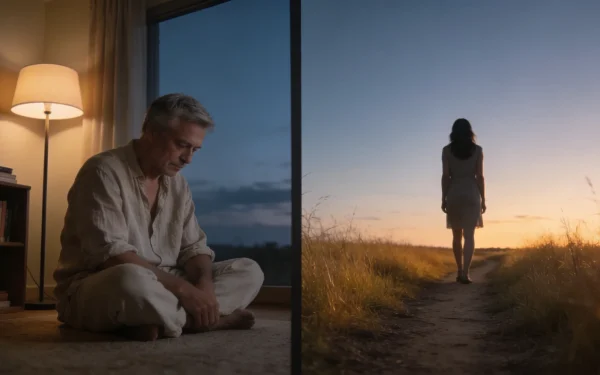
You didn’t search “this experience” looking for another concept to file away. You searched because something inside has gone quiet in a way that frightens you. Or loud in a way you can’t explain. Your chest is tight right now, maybe. Your stomach is hard. Your breath is shallow and has been for hours. And all the words you’ve collected about healing feel like they belong to someone else’s life.
You still function during the day. You answer messages. You show up. You do the work. Then night falls, and everything you held together starts pressing inward. The tightness comes back. The heaviness. The strange feeling that your own life doesn’t fit anymore.
Then shame arrives right behind it.
You should be past this.
You should know better by now.
You should be stronger after everything you’ve already done.
The night is not proof you are broken. It is proof something true in you refuses to stay unfelt.
You are not failing at healing. You are in a real stage of a real process. The chaos has structure — even when it feels shapeless from the inside.
By the end of this guide, you will know what stage you are in and what to do tonight so the spiral softens instead of deepens.
You don’t need a perfect belief system right now. You need something you can feel in your body. Orientation. One honest next step.
Why this can feel like collapse when people call it growth

It’s hard to trust the word “growth” when everything inside you feels like it’s coming apart.
Here’s the honest part: growth language sounds clean. Dark nights feel like internal demolition. Identity cracks. Meaning thins out. Old coping stops working. Relationships and priorities shift faster than your nervous system can process.
Historically, “dark night of the soul” comes from Christian mysticism — specifically Saint John of the Cross. Today, people use it more broadly to describe spiritual and existential disorientation, with or without religion (Wikipedia). Different framework, same underlying pattern: what used to orient you no longer holds.
Most people searching this are not chasing spiritual theory. They are trying to get through a hard night without turning against themselves.
Uncertainty is what hurts most.
Is this awakening?
Depression?
Burnout?
Grief?
A nervous system crash?
Sometimes it’s one. Sometimes it’s several tangled together. Spiritual framing can restore meaning. Clinical support can restore safety. These are partners, not rivals.
If you want the wider foundation, read this alongside: dark night of the soul.
The 7 dark night of the soul stages (and what each stage asks)

You don’t have to know all seven right now. Just find the one that sounds like tonight.
These stages move in waves, not a straight line. You may revisit the same stage and meet a deeper layer each time. Most people moving through this experience notice overlap, not clean separation.
1) The crack: your old life stops feeling true
On paper, life still works. Inside, it feels hollow. Conversations feel scripted. Achievements feel thin. Practices feel mechanical.
This stage often starts quietly. Music that once moved you feels distant. Social plans feel heavy. You hear yourself say “I’m fine,” and the words sound strange in your own mouth.
For this moment: stop forcing the old map. Name the mismatch. You don’t need immediate answers — just honesty about what no longer fits.
2) The collapse of certainty: soul collapse in plain language
The beliefs and tools that carried you lose their grip. You know what you’re supposed to do. You just can’t feel it land anymore.
This is where shame spikes — because it can look like regression. More often, it’s reorganization. The ground isn’t disappearing. It’s shifting.
The reflex here is to push harder. More content. More practices. More effort. That usually adds noise and delays contact with what is actually happening underneath.
For this moment: let “I don’t know yet” be honest, not humiliating.
3) The exposure: buried material rises
As control softens, unfinished pain surfaces. Grief. Fear. Anger. Helplessness. Old abandonment wounds you thought you’d already dealt with.
Not because you’re getting worse. Because what was frozen is now reachable.
It shows up in ordinary moments. A delayed text feels like rejection. A neutral tone feels like danger. Silence suddenly feels loud. Your body reacts before your mind understands why.
For this moment: sensation first, interpretation second.
4) The void: numbness and “nothing works”
This is where many people panic. Meditation feels dry. Meaning disappears. You wonder if you’ve lost yourself entirely.
The hidden tension: shutdown can feel like peace at first. This stage is often the bridge between old survival patterns and real regulation. It doesn’t feel like a bridge. It feels like nothing. That’s the hardest part.
Start concrete. Temperature in your hands. Contact with the bed beneath you. Tightness in your throat. Weight in your chest. Numbness is still a body state — and your body is still here.
For this moment: gentle contact, not dramatic effort.
5) The surrender edge: performance falls away
Surrender is not collapse. It’s the end of pretending.
There is fear.
There is grief.
There is anger.
At first this feels exposed, like walking outside without skin. Then it becomes steadier than control ever was — because you stop splitting from your own reality.
For this moment: honest naming without self-attack.
6) Re-embodiment: trust returns through the body
This stage is subtle. You sleep a little better. You recover faster after conflict. Hunger and fatigue become clearer signals instead of background noise. Your limits become easier to respect.
You stop proving your healing and start living it in ordinary decisions: saying no, resting, leaving early, drinking water, going to bed when you’re tired.
For this moment: rhythm over intensity.
7) Integration: life gets truer, not shinier
Insight becomes behavior. Boundaries become cleaner. Choices become less performative. You feel more like yourself — not a better version of yourself, just a more honest one.
Fear may still appear, but it no longer runs the room. Hard nights may still come, but they stop defining your identity.
For this moment: live one small truth consistently.
If this still feels abstract, use one filter tonight:
What stage am I in right now, and what is this stage asking of me today?
One honest answer will carry you further than ten perfect theories.
Why these stages repeat (and why that does not mean you are back at zero)

Feeling the same pain again doesn’t mean you failed. It usually means your body trusts you enough to go deeper.
When pain returns, the mind says, “I’m starting over.”
Most of the time, that’s not true.
Repetition often means life touched a deeper layer. New love can reopen old abandonment. Career shifts can trigger old worth wounds. Illness, grief, menopause, parenting strain, relocation, or breakup can reactivate what was never fully processed.
Track sequence, not just symptoms.
What happens first in your body?
What comes second?
What comes third?
For some people: chest tightens → thoughts race → urgency spikes → reactive behavior.
For others: numbness → disconnection → doom thoughts → shutdown scrolling.
That sequence is useful because it gives you early contact. In my experience, body signals show up before the mental spiral feels obvious. Your jaw braces. Your throat gets narrow. Your breath turns shallow. Your hands cool down. You stop feeling your legs on the floor. If you catch the pattern there, the wave is still workable.
This is where many people feel frustrated with this. They expect each cycle to disappear forever. What usually happens is more honest: each return gives you better timing. You notice earlier. You name faster. You recover with less damage. The wave may still come, but it doesn’t have to run your behavior for six hours before you realize what’s happening.
There is also an observer layer that gets stronger with practice. One part of you is flooded. Another part can still witness the flood. That witnessing doesn’t erase pain, but it changes your relationship to it. Instead of becoming the panic, you can notice panic moving through your body. Instead of becoming the shame, you can feel shame as heat, collapse, pressure, and breath restriction. That is depth work in plain language: not “thinking better,” but staying present long enough for sensation to tell the truth.
There’s another shift that matters here: the observer. One part of you is flooded. Another part can still witness the flood. That witnessing doesn’t erase pain, but it creates space around it. In that space, language changes.
“I am broken” becomes “fear is active in my body right now.”
“I failed again” becomes “a deeper layer is here.”
That is not wordplay. That is regulation beginning.
If symptoms become severe, clinical support is essential. Persistent hopelessness, inability to function, self-harm thoughts, paranoia, or prolonged loss of shared reality need immediate professional care. Useful starting points: NIMH depression resources and APA stress and trauma responses.
If your body is carrying more than your mind can hold right now, Write what you feel — 3 free answers, no sign-up — When something here made you pause, that pause is information. Your body knows more than your mind has caught up to.
One body-grounded practice for tonight
You don’t need to fix anything. You just need twelve minutes of not abandoning yourself.
You don’t need to solve your whole life tonight.
You need one honest point of contact with what’s actually here.
When this experience feel theoretical, this gives your body one direct way to orient.
12-minute stillness session
Permission
If tonight is heavy, this is enough. No fixing. No proving. Just staying.
Entry
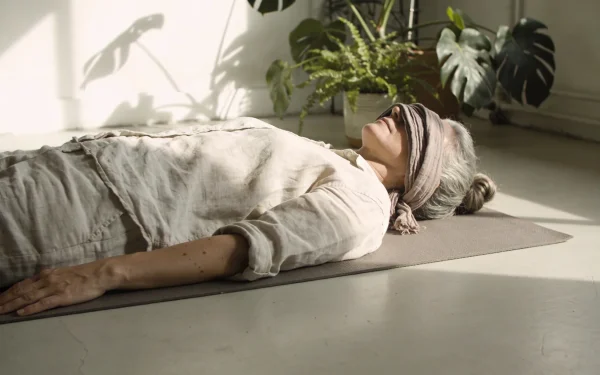
1. Lie down on a flat surface.
2. Place your hands beside your hips, palms facing down.
3. Close your eyes and cover them with a T-shirt or scarf.
4. Keep your body completely still.
Body location
5. Move your attention into your body and find the heaviest point — chest, throat, stomach, shoulders, or hands.
6. Stay with that exact point using plain sensation words only: pressure, heat, tightness, ache, burning, density, vibration, numbness.
Tolerance
7. If intensity rises too fast, widen your attention to two places where your body touches the floor.
8. Once you feel steadier, return to the heaviest point.
One quiet truth
9. Around minute eight, whisper one line: “There is fear in my chest.” or “There is grief behind my ribs.”
Integration
10. At minute twelve, ask yourself: “What softened by 5%?”
11. Write one line before sleep: “Today I am in stage . My next honest step is .”
If the mind starts analyzing, return to sensation. Not the story. Not the verdict. Just what is directly here.
What changes after this practice (and what remains true)
Something small shifts. Not everything. Not nothing. Just enough to breathe a little differently.
What changed: you stopped abandoning yourself at the exact moment intensity rose. The wave may still be there. But you are no longer fully inside it without orientation.
What softened: panic loses speed. Numbness becomes easier to recognize as protection rather than peace. Shame loosens when what you’re experiencing is named directly in body language — not interpreted, not judged, just felt and spoken.
What remains true: uncertainty may remain. Grief may remain. Fear may remain. But now there is a path through the wave while it’s happening. That’s the difference between suffering alone and meeting yourself in the middle of something hard.
If tonight is heavy, keep the bar low and specific. Set a 12-minute timer. Lie down exactly as written. Afterward, write one line: “Right now I am in , and my next honest step is .” That is enough for one night. It gives your system a direction when everything in you wants to disappear into noise.
The night is not proof you are broken. It is proof something true in you refuses to stay unfelt. That is the real center of dark night of the soul stages. Not becoming perfect. Not becoming untouchable. Staying with what is real long enough for your life to reorganize around truth instead of performance.
You don’t have to fight this by force. You can meet it with honesty, with gentleness, and with one true next step.
When you’re ready, try Feeling.app free →
3 answers. 30 seconds each. No credit card. Yours to keep.
The Feeling Session is the body practice this work is built around.
dark night of the soul symptoms describes the somatic side of the same opening.
Frequently Asked Questions
How do we get out of the dark night of the soul?
Start with orientation, not escape. Name the stage you’re in right now. Then take one stage-matched action today — something small, something your body can actually feel. Consistent body-based contact works better than intense spiritual effort. You don’t climb out all at once. You meet yourself where you are, and the ground steadies under you.
Why do dark night of the soul stages keep repeating?
Because life keeps opening deeper layers. A new loss, a new love, a new threshold — each one can touch something older underneath. Repetition usually signals readiness for deeper integration, not failure. If you’re back here again, it doesn’t mean you lost what you gained. It means there’s more of you available now.
How long does a dark night last?
There is no universal timeline. Some waves pass in weeks, while deeper integration can take months or longer. Safety, support, and your willingness to stay present all influence duration. What I can say is that naming the stage you’re in — honestly, without forcing it — tends to shorten the time you spend lost inside it.
Is this a spiritual crisis or a mental health issue?
Sometimes one. Sometimes both at the same time. If functioning drops sharply or self-harm thoughts appear, seek immediate clinical support. Spiritual framing can support recovery, but it should not replace professional care when risk is present. These aren’t competing paths. They can walk beside each other.
What is the difference between soul collapse and depression?
Soul collapse usually describes a crisis of meaning, identity, and inner direction — the feeling that what used to orient your life no longer holds. Depression is a clinical condition with diagnostic criteria. They can overlap, which is why combined support — body-based orientation alongside professional care — is often the most grounded path forward.
What should you do tonight if you feel overwhelmed?
Use the 12-minute stillness session exactly as written: lie down, palms down, eyes closed and covered, body completely still, attention on the strongest sensation. When the mind spirals, return to sensation. Not the story. Not the meaning. Just what is directly here in your body. That’s enough for tonight.
What is dark night of the soul stages?
This is a body-level experience, not just a thought pattern. It often shows up as chest tightness, shallow breathing, or a sense of heaviness — your nervous system responding to something it hasn’t fully processed. It is not a flaw. It is protection that outlived its purpose.
What causes dark night of the soul stages?
The causes are rarely single events. This typically builds from accumulated stress, relational patterns, unprocessed grief, or early environments where certain feelings were not safe to express. The body adapts, then the adaptation becomes the pattern.
A note on this work: The Feeling Session is a body-first emotional practice — not therapy, not medical care, and not a substitute for either. If you are in distress, dealing with severe symptoms, or unsure what you need, please reach out to a licensed mental-health professional. The information here reflects our lived experience guiding sessions; it is offered as support, not as diagnosis or treatment.