
Written by Rytis & Violeta · Feeling Session founders · Updated July 2026
· 17 min read

Why do I feel empty when life looks fine? Because emptiness isn’t the absence of feeling — it’s the lid your body built when feeling was never safe. The flatness behind the sternum at the kitchen table, the thinness in the throat when good news arrives and nothing moves: that is suppression so old it started feeling like you. The way through isn’t filling it. It’s lying still long enough that what’s underneath can rise into the chest.
As we write in our book The Door Home: A Book of Feelings: “We were taught not to feel. From this came an unhappy life. Chaos. Sickness. But feeling is our divine nature – you have it, no one could take it from you.”
You’re Not Empty. The Body Built a Lid.

You can name everything good in your life on paper. The job. The person. The apartment that finally feels like yours. The friends who would actually show up. You read that list out loud — and behind the sternum, there’s a flat, dull quality the list doesn’t touch. Not pain. Not sadness. Just a thinness in the chest that doesn’t move when the day starts going well.
That’s the question you typed at 3 a.m. Why do I feel empty when, by every measurement, I shouldn’t?
You’ve Googled it before. Build a vision. Restart a hobby. Journal more. None of it landed. The empty stayed.
Here’s the thing nobody named for you yet. The empty isn’t a thing missing. It’s a thing covering. A flat, gray quality in the chest doesn’t mean nothing is there. It means something underneath is being kept down — so quietly, for so long, that you mistook the lid for the floor.
The body learned, somewhere, that feeling = danger. Maybe at six. Maybe at sixteen. In a kitchen where the wrong tear got punished, or a room where the wrong anger meant being sent away, or a relationship where the wrong sadness made the other person leave the room. The body, being smart, did the only thing a body can do. It dimmed everything. It pulled the volume down on the inner life until nothing registered loudly enough to put you in danger again.
That dimming is what empty feels like. Not absence. Suppression so old it stopped feeling like suppression and started feeling like you.
Key Takeaways
- Emptiness isn’t the absence of feeling — it’s the body’s protection when feeling was never safe.
- A flat, dull quality in the chest, a thinness in the throat, a numbness behind the sternum: that’s where the lid lives.
- Vision and purpose prescriptions don’t reach this layer, because the layer is below thought.
- The way through isn’t filling the empty. It’s sitting with it long enough that what’s underneath can rise.
- Two levels live in you: the part feeling empty, and the part noticing the emptiness. The noticing part isn’t empty.
- One full hour of stillness moves more than a year of self-improvement, when the body finally feels permitted to feel.
- Empty isn’t proof you’re broken. It’s proof your system is still trying to protect you from something it never got to release.
Where Emptiness Lives in the Body

Pause for a second. Where does empty actually sit in your body, right now?
Most people land in three places. The chest — a flat, dull quality behind the sternum, like the heart has been wrapped in cotton. Not heaviness. The breath only goes halfway down before it forgets why it was going. The throat — a thinness, a closed-off feeling that has nothing to do with words. As if a small valve between the head and the heart got shut years ago. The stomach — a quiet sinking. Not hunger, not nausea. Just an absence of urgency.
Maybe yours is elsewhere. The shoulders, dropped but not relaxed. The jaw, set so long the molars have learned to find each other. The eyes, dry and tired in a way sleep doesn’t fix. The hands, vaguely cold. The skin, slightly muffled, like the world is happening through a thin layer.
Empty has texture. People miss this because they expect emotion to roar. They expect grief to crack and anger to burn. They don’t expect a feeling to feel like nothing — and so when the body produces nothing, they think nothing is happening. Nothing is happening on top. Underneath, plenty is happening. The lid is doing its quiet, full-time work of holding it all down.
The mind wants to make this a story. I’m empty because my job is meaningless. I haven’t found the right partner. I haven’t figured out who I am. All those frames send you back into thought — and thought is what built the lid in the first place. More thinking will not move what thinking already locked down.
Drop your attention into the chest, the throat, the stomach. Let the breath go a little slower. I’m not empty, you start to feel, before you have language for it. I’m covering something. That distinction is small in language, enormous in the body.
If even five quiet minutes feels too still to hold alone, Feeling.app is where Rytis and Violeta keep this practice — short body resets, the full method, in your pocket.
What Built the Lid (and Why It’s Not Your Fault)
Here’s what nobody told you about why do I feel empty.
The empty didn’t arrive. It was built. In small, quiet moments where a feeling rose up — and there was no one safe to feel it with. So the body did the only thing a small body can do. It pushed the feeling sideways. It made a face that didn’t match. It swallowed the cry. It kept moving so the feeling couldn’t catch up.
The first time you cried and someone said stop. The first time you got angry and someone bigger said that’s not nice. The first time you were scared and were told you’re fine. None of those people meant to build the lid. Most inherited their own from someone before them. But each time, a kid’s body learned the same lesson: this feeling doesn’t get to come up here. Push it down. Keep going.
Every time you said I’m fine when you weren’t, a small piece of feeling got filed lower than the chest — under the diaphragm, behind the ribs, in the hips. After enough years, the storage fills. The body, brilliant as it is, does the next thing. It shuts down the feeling system itself — and with it, the emotional intelligence you might have grown if the room had been safe enough to feel out loud. Not just the bad feelings. All of them. The system that lets sadness in is the same system that lets joy in. You can’t dim half. So the dimmer goes down on the whole thing. That’s the day empty arrived. Not as a problem. As protection.
The empty isn’t a bug. It’s the most successful protective move your body ever made. It kept you in rooms that weren’t safe to feel inside. It kept you functional through years where collapsing wasn’t an option — through burnout, through seasons no one knew you were quietly surviving. The lid worked. That’s why it’s still here.
So when you ask why do I feel empty? — the body’s honest answer is: because for a long time, that was the only way I knew to keep you alive. That’s not a bug to delete. That’s a body that has been waiting, sometimes for decades, for a moment quiet enough to safely take the lid off.
What You Think Emptiness Is vs What It Actually Is
The mind sees one frame. The body knows the other. Most of the suffering inside emptiness comes from running the wrong frame.
| What you think emptiness is | What it actually is |
|---|---|
| Proof that something is broken in you. | Proof your body still has a working protective system. |
| The absence of feeling. | The presence of too much feeling, kept down. |
| A purpose problem. I haven’t figured out what I want. | A safety problem. I never got to feel without consequence. |
| Solved by adding meaning, goals, vision, hobbies. | Solved by sitting with it long enough that what’s underneath can rise. |
| The deepest, truest thing about you. | The lid on something deeper and truer than the lid. |
| Permanent. This is just who I am now. | A state — and states move when the body is met instead of managed. |
If your last five attempts have been in the left column and nothing has shifted, the column was the problem. Not your effort. The frame.
In The Door Home we name this emptiness differently than the culture does. Fear of empty being — nothing happening, no phone, no plan — drives perpetual action. Busyness packs unfelt feeling under tasks; we call that being packed under your doing. When you finally stop, the empty surfaces. And befriending that empty space in the present is what creates the feeling I am. Emptiness tasted without music or scrolling is not a void. It is full of you.
This is also why purpose prescriptions fail. As we write in the same book: “You walk into a room where the furniture is arranged. Just like that. And you simply don’t rearrange the furniture. That’s it. You’re happy. The room is this moment. The furniture is everything in it.” The empty often is resistance to the room as it is — a push against what is already here.
Two questions. Don’t answer with the head. Sit with each one for the time it takes to do one slow breath.
What feeling, as a kid, did the room around you not want to receive?
What feeling, today, do you still treat the same way that room did?
The body knows both answers. They might not arrive in language. They might arrive as a memory. As a sensation that sharpens behind the sternum. As a quiet ache between the shoulder blades. That is the lid loosening, just slightly, because something finally asked it the right question.
If this is bleeding into a wider sense that nothing matters, life feels meaningless is the same body signal louder. If it’s specifically the loss of fire and pull, no motivation to do anything names that exact register. The empty here and a deeper feeling lost in life are next-door rooms. And if the system has gone fully offline — flat affect, distance from your own days — the emotional numbness layer is what to read next.
Two Levels: The Empty Part, and the Part That Notices
Here’s what changes everything. Once you feel it, you can’t unfeel it.
There are two levels in you, right now, reading this.
The first is the empty part. The chest is flat. The throat is thin. The stomach is quiet. The breath is shallow without urgency. The mind has been asking the same question for months — why does none of this reach me? That part is real. That part is the lid, and what the lid is keeping down.
The second level is harder to notice, but it has been here the whole time. It’s the part of you that just registered the previous sentence. The part that watched the chest go flat and could name the flatness. The part that’s been quietly observing the empty for months — sometimes years — from a steady seat behind the noise. The part that wrote your search query at 3 a.m.
Those are not the same part. There is the empty. There is the part of you noticing the empty. Two levels. Same body.
The second level — what we call the watcher in The Door Home, beside the actor who performs “I’m fine” — is the most overlooked thing in this whole conversation. You can have a chest that feels nothing, and a part of you that notices the chest feels nothing, in the same instant. The noticing part is not empty. It has been the most loyal piece of you the whole time — the one keeping a quiet record while you kept performing. The one that finally, at 3 a.m., refused to keep performing alone.
That part isn’t the lid. That part is the proof someone is still home, under the lid.
The body, in stillness, lets the second level come forward. Not as a thought. As a quality. A subtle, steady alertness — I’m here, watching this — that the empty cannot occupy. You don’t have to believe in the watcher for it to be real. You just have to stop drowning it out.
The Practice: A Full Feeling Session
This is the one place I’ll ask you to do something physical. Not a hack. Not a routine. The deep practice this whole article is built around. The one that lets the watcher meet the empty and lets the empty start, finally, to move.
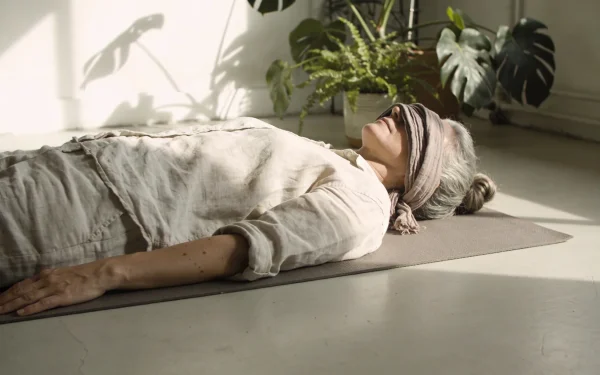
Lie on your back. Bed, mat, or the floor. Whatever’s nearest. Don’t make a project of it.
Palms down, beside your hips. Arms relaxed and straight along your sides. Not on the chest. Not on the belly. Not crossed. Not folded. Just down, doing nothing.
Cover your eyes. A scarf, a T-shirt, anything soft, like a small compress. Eyes closed underneath. The dark drops the attention inward.
Body still. The bed is holding you. You don’t have to hold yourself.
Nothing on your body. No phone on the chest. No cat. No weighted blanket. No hand. The body fully open and free.
Then — you do nothing. That is the practice.
Whatever rises — the flatness, the chest dullness, a sudden grief, an old anger, tears that come without a story attached — let it rise. Don’t follow it with thought. Don’t analyze it. Don’t try to make it into something pretty. Stay with the body sensation underneath, while the watcher watches.
Stay until it completes. The dentist analogy is the cleanest one Rytis uses. You don’t get up halfway through a tooth. You sit there. You let the work finish. The lid, met like this, doesn’t dissolve in five minutes. It softens in waves. Sometimes the chest opens for one breath, then closes again. Sometimes a feeling you didn’t know you had rises into the throat. Sometimes nothing visible happens for forty minutes, then a single tear, and the breath goes deeper than it has in a year. All of that is the work.
When you sit up, move slowly. Drink water. Don’t go straight back to a screen.
I noticed it on day forty-something of my own practice — flat on the floor in Plateliai, scarf over my eyes. The chest had been dull for weeks, that thin gray quality that doesn’t yield to anything. Around the half-hour mark, I caught myself watching the dullness. Not being it. Watching it. The dullness, for one breath, became something happening in a chest, observed by something steady. I didn’t feel full. I felt accompanied, by the part of me that had been there the whole time. The lid moved a millimeter. That millimeter changed everything.
When you’re ready to give the body a real hour — eyes covered, body still, the deep practice — Feeling.app carries the method as we teach it.
Don’t rearrange the furniture — from our book
If a full hour feels too far tonight, start here. From The Door Home:
- Notice where you say, inside, this should not be — the empty chest, the flat Sunday evening, the life that “should” feel different.
- Soften the “no.” Don’t force a yes. Just stop pushing against the moment.
- Practice: don’t rearrange the furniture of this moment. Leave the empty as it is for a few minutes.
- Optional breath: on the in-breath, only; on the out-breath, here.
- Ask once, without answering from the head: is anything actually lacking now, or is the lack a story about later?
Relief in the body is the measure — not a revelation about your purpose.
Tonight, Just This
You don’t have to do the deep practice tonight. If five minutes is what you have, five minutes is enough. The body isn’t asking for a project. It’s asking for less hostility.
Notice once where empty lives in your body. Don’t analyze. Chest, throat, stomach, jaw, eyes, shoulders — name where it sits. The naming is the watcher introducing itself.
Don’t make any large life changes for the next two weeks. Empty is a poor strategist. Anything chosen from inside the lid will be chosen by the system that built the lid.
Subtract one thing you already know is dead. The scrolling. The performance you’re tired of. Subtraction creates the room feeling can re-enter.
Violeta says it like this. The body doesn’t lie. It just waits. Yours has waited a long time. It is asking for one quiet hour where you stop performing fullness and let the thing underneath the lid come up to the chest. The Feeling Session is the practice this article is built around. There’s feeling empty as a live, in-the-moment state, and there’s the longer-arc territory of what am I doing with my life and the dark night of the soul — different rooms in the same house. Whichever door you walk through, the body comes with you. That’s the only piece that matters.
You’re not empty. You’re covered. The covering kept a kid alive once. It is asking now, gently, to be allowed to lift. Not because you’re broken. Because you finally got quiet enough to hear it ask.
What People Say When Feeling Returns
A few months ago I was existing and quietly dying inside — that insane torment when everyone else is always to blame… But it turns out it isn’t like that, and that weight can be lifted. It isn’t an easy path, but it’s priceless.
— Jurgita S.
Before, I lived only in my head. The body was just the thing that carried my head around. After a few sessions I feel that I’m living. I feel my chest. I feel my belly. I can’t believe how much I had suppressed because of other people’s opinions.
— Laura
Frequently Asked Questions
Why do I feel empty all the time?
Because the lid has stopped lifting at any point in your day. When the body has been suppressing feeling for years, the dimmer goes from “evenings only” to “always on.” The chest stays flat through good news. The throat stays thin through good company. That’s a nervous system that hasn’t met a quiet enough room to safely take the lid off. Stillness — not stimulation — is what shifts it.
Why do I feel empty for no reason?
There is a reason. It just isn’t where the mind is looking. No reason usually means no current event triggered it. The empty isn’t responding to today. It’s the body finally getting quiet enough to register what it has been carrying for years. Empty arriving “out of nowhere” is often the lid loosening just enough for what’s underneath to send up its first signal.
Is feeling empty a sign of depression?
It can overlap. Persistent emptiness with hopelessness, sleep changes, or thoughts of self-harm should bring you to a licensed professional. But empty exists outside clinical depression too. People with full lives and clean bloodwork still feel empty when their feeling system has been dimmed for years. Get an honest read from a doctor. Alongside that, the body work doesn’t get skipped.
Is feeling empty the same as feeling numb?
They’re cousins, not twins. Numb is the deeper shutdown — the body offline, sensation distant, volume low across the whole system. Empty is the version where you can still locate sensation, but it has a flat, dull, hollow quality. You can usually still cry at a movie. You just can’t cry about your own life. Numb is full shutdown. Empty is the system running with the lid on.
How do I stop feeling empty inside?
Not by adding more. Not by finding the right vision or the right partner or the right city. You stop it by sitting with the empty long enough that the lid begins to soften. Lie down. Cover your eyes. Palms down beside your hips. Body still. Let what’s underneath come up at the body’s pace. Empty stops being chronic when it’s finally allowed to move instead of being managed.
Why does my life feel empty even when it’s full?
Because the empty isn’t measuring your life. It’s measuring how much of your life you’ve been allowed to feel inside your own body. You can have a partner, work, home, friends — and still have a body that learned, decades ago, that feeling was unsafe. The list is real. The lid is also real. They live in different layers, and don’t talk to each other until the body becomes a place feeling is safe again.
Is feeling empty a sign of trauma?
Often, yes — though “trauma” gets used loosely. What we mean is: the body learned, somewhere, that having a feeling led to a worse outcome than not having it. That learning doesn’t need one big event. It can come from a childhood of low-grade emotional neglect, or relationships where your real responses kept getting punished. The empty is what the file cabinet looks like from the inside.
Can therapy help with chronic emptiness?
Talk therapy can help you understand the shape of the lid. The right therapist gives you language and a witness. But understanding the lid is not the same as moving it. Many people stay stuck for years naming the pattern from the head while the body stays exactly as covered. The pattern needs language and the body needs stillness. Therapy plus body practice tends to do what either alone often can’t.
How long does it take for the empty to lift?
There’s no clock. It depends on how long the body has carried the lid, and how consistently it gets met. Some people feel the first crack within a few sessions — a chest that softens for one breath, a tear without a story. Others take months of daily stillness before the body trusts it. The lid was built quietly, over years. It usually doesn’t come off loudly.
What if the empty actually scares me?
Then you’ve already done the most important thing — you’ve named it. The fear of the empty is itself information. It usually means the lid is starting to move and the body is sensing what’s underneath. Shorter sessions. Eyes covered. A trusted person within reach. The empty is much smaller than the system that built it. The watcher in you is bigger than both.
A note on this work: The Feeling Session is a body-first emotional practice — not therapy, not medical care, and not a substitute for either. If you are in distress, dealing with severe symptoms, or unsure what you need, please reach out to a licensed mental-health professional. The information here reflects our lived experience guiding sessions; it is offered as support, not as diagnosis or treatment. If you are in acute crisis, contact local emergency services (in Lithuania: 112) or a crisis line near you — this practice is not for unsupervised work in acute crisis.
What does it mean when you feel empty?
Underneath, it’s almost always simpler than the mind makes it — a sensation, a held breath, a younger part still waiting to be heard. Notice where you feel it — chest, throat, stomach, jaw. The body signals first; the mind interprets after.
What is the first stage of a mental breakdown?
By the body’s measure, it means a part of you has been carrying weight that hasn’t been allowed to be set down. Stay with the sensation underneath the question. That’s the doorway.