
Written by Rytis & Violeta · Feeling Session founders · Updated May 2026
· 10 min read

If you searched this experience, you’re probably not looking for theory. Something is happening in your body right now — chest pressure, buzzing, tears that come from nowhere, numbness, heat, shaking, dread, or sudden exhaustion that drops the moment life gets quiet — and you’re trying to figure out whether you can trust it. Then shame arrives: Shouldn’t I be calmer by now? Shouldn’t all this practice be working?
This experience are not proof something is wrong with you. They’re a sign your body and inner life have been carrying too much alone.
You’re not broken. And by the end of this guide, you’ll know what to do when the next wave hits.
Here’s the turn that matters: body sensations are usually not a detour from your path. They’re often the clearest part of it. The real issue is rarely “Is this spiritual or psychological?” The real issue is not knowing what to do in the moment — the three a.m. moment, the one where your chest is pounding and your mind is spinning and nothing you’ve read seems to land. This guide gives you that next step: a grounded map, clear safety boundaries, and one practice you can use tonight.
When your body gets louder than your beliefs

Sometimes the knowing in your head and the panic in your chest don’t match. That’s not a sign you’ve failed — it’s the place the real work begins.
The core tension is simple and real: your mind may feel spiritually informed while your nervous system still feels unsafe.
You can understand presence and still feel panic in your chest. You can know all the language and still go numb at night. You can believe you’re surrendering while your jaw, throat, and stomach are bracing for impact.
That gap is what creates so much confusion.
Some people call this “energy movement.” Clinical frameworks call it autonomic activation, shutdown, and recovery patterns. These lenses don’t need to compete. They often describe different layers of the same moment. The useful question is not which worldview wins. The useful question is: what state is my system in right now, and what support matches that state?
The vagus nerve helps mediate shifts between mobilization, settling, and shutdown. So nervous system regulation is not about becoming permanently calm. It’s learning to notice state shifts earlier and respond with precision instead of panic.
Two misunderstandings keep people stuck:
- Intense means dangerous.
- If I can explain it, it should stop.
Sometimes intense symptoms do require medical evaluation — and I’ll name those clearly below. But many intense waves are information, not failure. Insight helps. But contact is what changes things. That is why somatic release can feel unexpectedly real: tears with no story, a throat opening, breath dropping on its own, warmth returning to a place that felt frozen for years.
Your body is not interrupting awakening.
Your body is where awakening becomes honest.
A practical map of spiritual awakening body sensations

Not a diagnosis. An orientation — so the next time your body does something unfamiliar, you have somewhere to start.
Use this as orientation, not diagnosis. Most people move between these states in waves.
1) Activation: when everything speeds up
Your system is mobilized. Heart races. Breath gets shallow. Chest and face heat up. Jaw tightens. Thoughts become urgent and repetitive. The inner message is: Fix this now.
What helps is not more interpretation. What helps is containment. Name the state directly: “Activation is here.” Then reduce stimulation and give your attention one task: find the strongest pressure point in your body and stay there for one minute without adding a story.
2) Shutdown: when everything goes flat
This state can feel like emotional distance, heavy limbs, numbness, fog, and disconnection from meaning. Many people panic here and assume they’ve “lost their path.”
In many cases, this resembles a freeze response. Not laziness. Not some kind of failure. Protection under load. Your system is conserving energy because it is over threshold.
What helps is gentle re-entry, not intensity. Small contact. Short duration. No pressure to feel something dramatic.
3) Release: when held material starts moving
You may notice trembling, yawning, sighing, tears, temperature shifts, grief waves, or a sudden drop in muscular tension. Some call this trauma release. Sometimes that fits. Sometimes it’s accumulated stress finally discharging.
Both can be true. Not every release is dramatic. Quiet release counts: one fuller breath, one unclenched shoulder, one thought loop losing charge.
Long-term stress can significantly affect sleep, mood, pain sensitivity, and immune health (MedlinePlus). So when stored load starts moving, unfamiliar sensations are expected.
4) Integration: when life feels ordinary again
This part is subtle. Many people miss it entirely. Fewer spikes. Faster recovery. More honest boundaries. Less need to explain your process to everyone. You still feel deeply, but you’re less afraid of feeling.
Integration does not feel like fireworks. It feels like your life becoming livable again.
If shutdown and heaviness are your main pattern, the guide on depression and spiritual awakening goes deeper without pathologizing what you’re living.
When to seek medical care first
Seek immediate medical care for new severe chest pain, fainting, sudden neurological symptoms, suicidal thoughts, or any acute symptom that feels medically unsafe. Responsible spirituality includes practical safety.
Why sensations intensify so fast

It’s rarely just the sensation. It’s the loop that wraps around it — the meaning, the fear, the bracing — that makes it feel unbearable.
Most of the suffering here comes from the loop around the sensation, not the sensation itself.
A common pattern is: sensation appears → mind races to meaning → fear rises → body braces harder → sensation increases → self-trust drops.
This loop intensifies with sleep debt, constant self-monitoring, social masking, and comparison with curated “peaceful awakening” stories online. Another amplifier is cognitive overwork: trying to solve in thought what is still unresolved in tissue, breath, and felt sense.
State-matched support is usually the deciding point. In activation, choose containment over intensity. In shutdown, choose gentle contact over force. In release, choose permission over interpretation. In integration, choose consistency over novelty.
One question can interrupt a hard night: “What state is here, and what would help this state feel 5% safer?”
If your body is carrying more than your mind can hold right now, Start with one honest sentence — 3 answers free — When something here made you pause, that pause is information. Your body knows more than your mind has caught up to.
A 12-minute body practice when the wave hits
You don’t need to understand the wave. You need to be with it — honestly, gently, without trying to make it mean something.
This is the immediate step. Use it when you feel flooded, numb, shaky, restless, or spiritually disoriented.
Permission first: you do not need to fix the wave. You only need to stay in kind contact with one part of it.
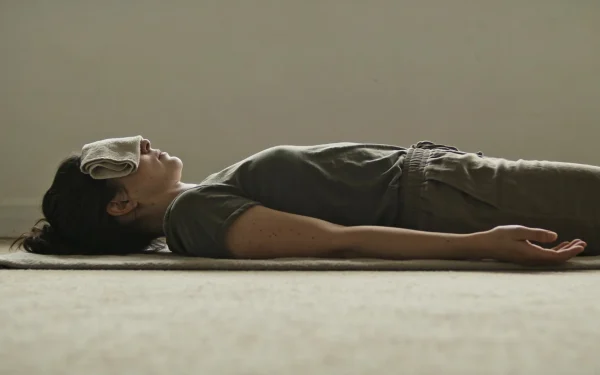
Lie down on a stable surface. Keep your body still. Place your hands beside your hips, palms facing down. Close your eyes and cover them with a soft T-shirt or scarf. No swaying, rocking, stretching, or breath control.
Set a gentle 12-minute timer.
-
Minutes 0–2 | Entry
Notice the urge to solve, label, or escape. Let each urge pass without following it. -
Minutes 2–6 | Body location
Find the heaviest point: chest, throat, stomach, eyes, shoulders — wherever the charge is strongest. Stay with that exact location. -
Minutes 6–10 | Tolerance
Keep your attention there. Sensation may intensify, soften, move, or go blank. All four are valid. When story starts, return to raw sensation. -
Minutes 10–12 | Quiet truth + integration
Before opening your eyes, silently name three lines:
This was real.
I stayed.
I can return.
Then open your eyes slowly. Sit up when your body is ready.
That is the full practice.
What changes after you practice this for real
The first thing that shifts is not the sensation — it’s the fear around it.
What changes first is small but decisive: fear stops running the room.
The sensations may still come. But they stop feeling like a verdict on your worth or your progress. You recover faster after spikes. You trust your timing more. You spend less energy swinging between “I’m awakening” and “I’m failing.” The body shifts from enemy to signal.
What softened: the panic, the urgency, the need to decode every sensation in real time.
What changed: your response became more precise, kinder, and more repeatable.
What remains true: you still feel deeply — and now you know what to do with what you feel.
That is the layer most people miss. Not a new identity. Not permanent calm. A reliable way to return.
When the wave comes tonight, skip the argument in your head. Lie down, palms down, eyes covered, and stay with the heaviest point for 12 minutes. Clarity is not something you think your way into; clarity arrives when you stop leaving your body.
You may not get a dramatic breakthrough. You may get something quieter and more valuable: less force in your chest, less fear around sensation, and one honest moment where you stop performing and start feeling. That moment is the path. Repeat it, and your life becomes more livable from the inside out.
You do not have to fight this experience by force. You can meet them with honesty, gentleness, and one true next step.
You do not have to fight this experience by force, but you can meet them with honesty, gentleness, and one true next step.
When you’re ready, try Feeling.app free →
3 answers. 30 seconds each. No credit card. Yours to keep.
The Feeling Session is the body practice this work is built around.
Frequently Asked Questions
Why do spiritual awakening body sensations get stronger at night?
Night strips away distraction and performance. The signals your body mutes during the day get louder in stillness. Fatigue also lowers the mind’s ability to override sensation, so unresolved activation or shutdown becomes easier to feel. You’re not getting worse. You’re just finally quiet enough to notice what was already there.
Is this spiritual awakening or anxiety?
Often both, at the same time. Spiritual meaning and nervous system activation can coexist without canceling each other out. The more useful approach is state-based: notice what your body is doing right now, then choose support that matches that state — not the label.
Can meditation make spiritual awakening body sensations worse?
Yes. For some nervous systems, long inward focus without structure can intensify activation or deepen shutdown. Short, time-bound, body-specific contact — like the 12-minute practice above — is often safer and more effective than open-ended sitting.
How do I tell somatic release from overwhelm?
Release usually includes at least some movement toward settling: a fuller breath, softening in the muscles, tears that feel like they complete something, warmth, clearer orientation. Overwhelm usually narrows everything: more panic, more confusion, fragmented thinking, and less capacity to stay present. If you’re unsure, shorten the practice and check in gently.
What should I do if numbness is the main symptom?
Treat numbness as protection, not a problem to solve. Use very small doses of contact: short stillness, brief sensory check-ins, and low-pressure body awareness. Forcing strong emotion when freeze is dominant tends to backfire. Go slowly. Your system has good reasons for shutting down.
When should I pause spiritual practice and seek medical help?
Pause and seek immediate care for severe chest pain, fainting, sudden neurological symptoms, suicidal thoughts, or any symptom that threatens safe daily functioning. Taking care of your body is not a spiritual detour — it’s part of the honesty this path asks of you.
What is spiritual awakening body sensations?
This is a body-level experience, not just a thought pattern. It often shows up as a racing heart, tense shoulders, or a persistent sense of unease — your nervous system responding to something it hasn’t fully processed. It is not a flaw. It is protection that outlived its purpose.
What causes spiritual awakening body sensations?
The causes are rarely single events. This typically builds from accumulated stress, relational patterns, unprocessed grief, or early environments where certain feelings were not safe to express. The body adapts, then the adaptation becomes the pattern.
A note on this work: The Feeling Session is a body-first emotional practice — not therapy, not medical care, and not a substitute for either. If you are in distress, dealing with severe symptoms, or unsure what you need, please reach out to a licensed mental-health professional. The information here reflects our lived experience guiding sessions; it is offered as support, not as diagnosis or treatment.