


You didn’t search spiritual bypassing nervous system because you need another concept to file away. You searched because something in your actual, lived experience doesn’t line up with what you’ve learned. You can name your patterns. You can hold compassionate perspective. You can understand your history clearly. And still — your chest tightens when the house gets quiet.
This spiritual bypassing nervous system loop feels confusing because your insight is real. Your understanding is genuine. Yet your body still doesn’t feel safe.
I want you to leave this page with one clear step you can trust tonight, so this stops feeling vague and starts feeling workable.
Nothing is wrong with your character. Nothing is wrong with your sincerity. Your system is doing what protective systems do when insight moves faster than felt safety.
Here is the turn that changes everything: the problem is usually not that you’re failing your spiritual practice. The problem is that your nervous system hasn’t been fully included in it. Once the body is included directly, the path gets clearer than it looks right now.
Why spiritual practices can calm your mind and still leave your body braced

*Sometimes the wisest part of you still can’t unclench its jaw.*

The core tension is simple and easy to miss. Many spiritual tools train awareness, meaning, and perspective. Your autonomic nervous system responds to sensation, threat prediction, and the completion of stress responses. When those layers split, you can sound clear and still feel unsafe.
You can forgive in your mind while your belly stays hard.
You can breathe slowly while your jaw is still locked.
You can “witness” beautifully while your chest never unclenches.
That isn’t fake spirituality. It’s incomplete integration.
In a spiritual bypassing nervous system pattern, regulation gets confused with emotional absence. And that confusion keeps the body braced.
One of the biggest confusions here is treating regulation as “feeling good.” Regulation isn’t constant softness. Regulation is flexibility — activation, settling, activation, settling — without getting trapped at either extreme. Numbness isn’t regulation. High-functioning overcontrol isn’t regulation either. Both can be adaptive. Both can still be costly.
This is where freeze response hides in plain sight. Freeze often looks calm from the outside. Inside, it feels blank, heavy, far away, or oddly exhausted. Many people interpret this as maturity or detachment. In the body, it’s often immobilized survival energy waiting for safe contact. If you recognize this pattern, these spiritual bypassing signs can help you name what’s happening without shame.
From a nervous-system perspective, bypassing often sounds wise while functioning as avoidance. Interpretation instead of sensation. Spiritual language instead of emotional contact. Transcendence before grief doesn’t reorganize because pain was explained well. It reorganizes when sensation is met in tolerable doses, with enough safety, for long enough. The spiritual bypassing nervous system response changes through repetition, not through perfect insight.
Your body is not sabotaging your growth. It is showing you the unfinished part of it.
What long-term bypassing teaches your nervous system

*Your body learned that feeling itself was the danger. That lesson doesn’t just fade on its own.*

Over time, spiritual bypassing nervous system conditioning installs a quiet rule: some feelings are too dangerous, too costly, or too relationally risky to stay with. Once that rule is in place, your nervous system starts reacting not only to life stress but to feeling itself.
This is why small moments can hit like large threats.
A delayed text. A flat tone. A quiet room at night.
Many people describe this as feeling stuck after spiritual awakening-of-grief/)-of-grief/)-of-grief/)-of-spiritual-awakening/), even when they’re still doing all the “right” practices.
The underlying mechanism is layered. Suppressed emotion doesn’t disappear — it becomes baseline load. Micro-contractions accumulate in your throat, diaphragm, jaw, shoulders, stomach, pelvic floor. Then ordinary stress stacks on top. Capacity narrows. Recovery slows. Even when life looks “fine,” your internal margin gets thinner.
This creates a painful paradox. You can become more competent and less regulated at the same time. You keep functioning. You keep caring for people. You keep doing your practices. But the off-switch weakens. When the day ends, unfinished activation rises, and it feels like anxiety from nowhere.
It’s rarely from nowhere.
The vagus nerve matters here, but online advice often flattens it into a quick fix. It’s one part of a broader regulation network shaped by history, context, body state, and relationship. This vagus nerve overview is useful for anatomy. The practical truth is simpler: your system updates through repeated experiences of safe feeling, not a one-time technique.
The same applies to conversations about trauma release. Evidence-informed practice favors titration — small, workable cycles of contact and settling. Too much too fast can reinforce threat. Too little contact changes nothing.
When bypassing is active, it often looks like this in daily life:
You speak compassion while resentment burns in your chest.. You can explain your grief but cannot cry without bracing.. You mediate conflict calmly while your pulse races.. You confuse dissociation for spiritual distance.. You chase elevated states because ordinary presence feels unbearable..
If symptoms are severe, persistent, or destabilizing, this NIMH PTSD resource is a solid place to begin alongside professional support.
And one honest thing: the longer bypassing protects you, the more it can feel like identity. That’s why this loop can be hard to unwind alone.
When meditation starts to feel worse, not better

*You’re not doing it wrong. Your body might just be doing something different than your mind told you it would.*
Many people whisper this question because they feel ashamed of it: “Why do I feel worse when I finally sit still?”
Because stillness removes distraction. What was muted can finally be felt.
For many people, this response strain becomes obvious in silence. There’s less room to outrun sensation.
This doesn’t automatically mean meditation is harmful. It usually means the method and your current state are mismatched. A practice that helped in one season may stop helping if it keeps you in observation while your body needs direct contact. If this is happening, read why meditation makes you feel worse and how to feel your feelings when you’re numb for next-step support.
Three states are often confused:
- Witnessing: You observe thoughts and sensation while staying embodied enough to remain present.
- Numbing: You feel less because the system shut down, not because it integrated.
- Flooding: You’re pulled outside your window of tolerance and can’t stay oriented.
Bypassing often oscillates between witnessing and numbing while avoiding skillful movement through flooding.
That’s why “just meditate more” can fail. In freeze, more stillness without sensation contact can deepen disconnection. In high activation, forced stillness can feel like pressure with no exit.
So nervous system regulation becomes precise. Not “make yourself calm.” But “create conditions where your body can process what’s already here.”
Calm that requires suppression is not calm. It is freeze with good branding.
If you need something steady right now, Name the pattern — 3 free answers, no credit card — If this reached something in you, there’s a next step that doesn’t require figuring anything out first.
A body-first reset you can do tonight when you feel stuck
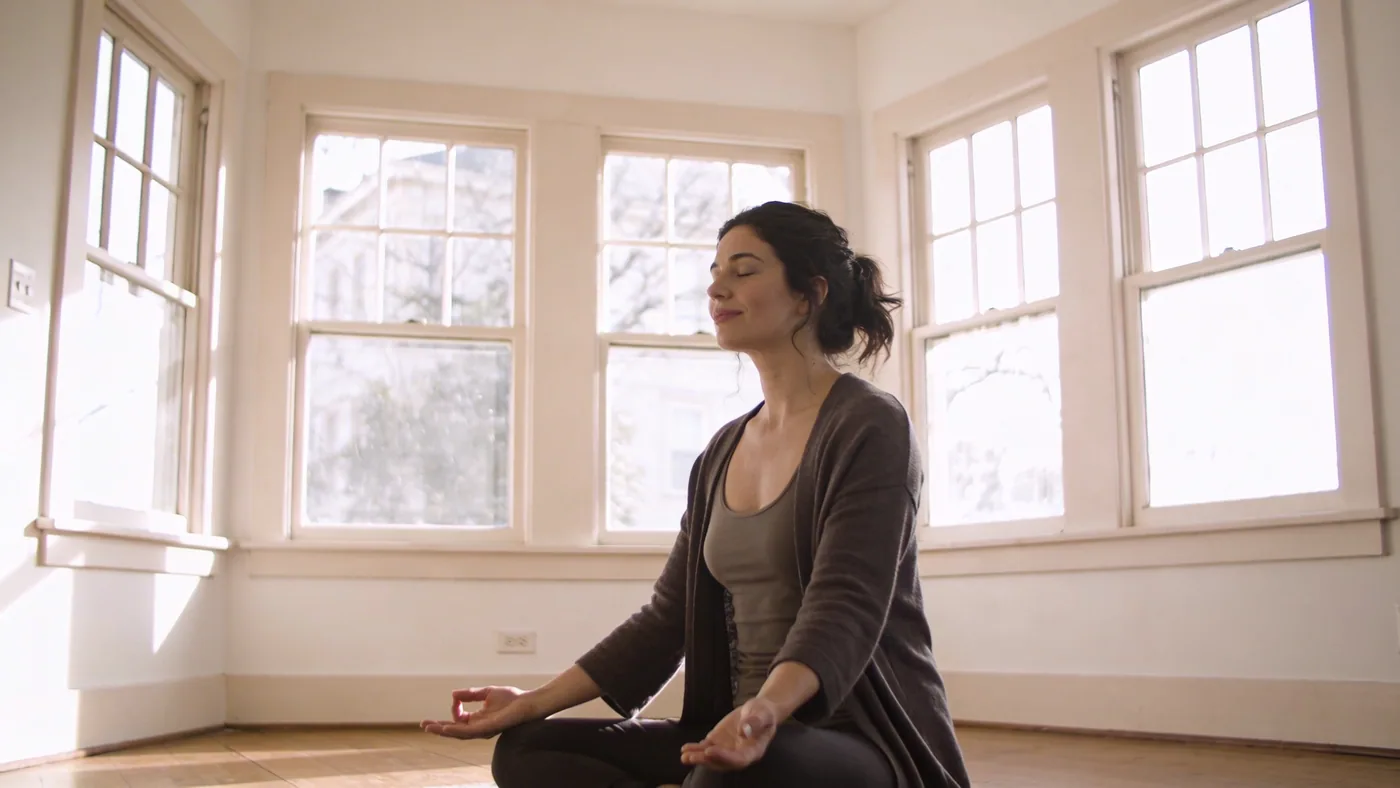
*You don’t need more understanding tonight. You need one moment where your body believes it’s allowed to feel.*

You don’t need a bigger belief tonight. You need one repeatable experience of safety in your body.
The 12-minute stillness practice
Permission
Start small. You’re not trying to heal everything. You’re teaching your system that one feeling can be met without being forced, fixed, or explained.
Entry
- Lie on your back on a stable surface.
- Place your hands beside your hips, palms facing down.
- Close your eyes and cover them with a T-shirt or scarf.
- Keep your body still. Do not sway, rock, stretch, or adjust unless there is pain and you need to stop.
Body location
- Move attention out of thought and into sensation.
- Find one spot with the strongest pressure, heaviness, tightness, ache, or charge.
Tolerance
- Stay with that one exact spot for 12 minutes.
- No analysis. No story. No reframing.
- If thoughts pull you away, return attention to the same body location.
One quiet truth
You don’t need to feel better to be doing this correctly. You only need to stay in honest contact.
Integration
- When the timer ends, keep your eyes closed for 30 seconds.
- Notice one shift of about 2%: breath depth, temperature, pressure, emotional tone, or contact with the floor.
- Name that shift in one sentence, out loud or in writing.
That’s the whole practice.
If intensity climbs too high, shorten the session. Smaller doses are precision, not failure. If you have severe trauma history or destabilizing symptoms, add qualified professional support so the process stays titrated and safe.
What shifts after one honest week of body-first practice
The first thing that changes isn’t how you feel. It’s how accurately you can name what you feel.

The first shift isn’t bliss. It’s accuracy. You stop mislabeling your state.
You stop calling shutdown peace.
You stop calling panic intuition.
You stop calling overcontrol discipline.
That accuracy softens shame. Your internal story finally matches your lived sensation.
Then pacing changes. You stop trying to win healing and start practicing return. The nervous system trusts repetition more than intensity, so small daily contact tends to outperform dramatic emotional effort.
Then relationship with feeling changes. Feelings stop being enemies and become information. Anger points to boundary strain. Fear points to pacing needs. Grief points to what matters. Shame points to belonging pain. Life may not become instantly easier, but it becomes more workable because you’re no longer fighting your own signals.
What changed: your map is clearer.
What softened: the war with your body.
What remains true: you still have feelings to meet, and now you know how to meet them.
Your nervous system is not blocking your spiritual path. Your nervous system is your spiritual path.
Tonight, set a 12-minute timer. Meet one sensation. Track one 2% shift. Repeat tomorrow.
What often changes first is not the whole story, but the amount of force inside it. When this response is named honestly, your body usually stops wasting so much energy on hiding, bracing, and pretending to be fine. That’s where clarity begins. You might notice a little less pressure in your chest. A little more room in your breathing. A little less panic around what this means about you. Those aren’t small things. They’re signs that truth is starting to replace performance. And when truth returns, you can choose what actually restores you instead of repeating what only keeps you depleted.
You don’t have to fight what you carry by force. But you can meet it — with honesty, gentleness, and one true next step.
When you’re ready, try Feeling.app free →
3 answers. 30 seconds each. No credit card. Yours to keep.
Pause here. Lie down or sit with feet flat on the floor. Let your hands rest beside your body, palms facing down. Close your eyes. Breathe into the tightest place. Notice where in your body you feel what you just read. Stay there for thirty seconds. That contact is already the practice.
Frequently Asked Questions
Why do we still feel this even when we “know better”?
Because knowing and feeling safe are two different things happening in two different parts of you. Understanding gives your mind direction. But the protective patterns in your nervous system update through repeated embodied contact — through your body actually experiencing that it’s okay to feel. Insight alone, no matter how clear, can’t do that job.
Can spiritual bypassing create physical symptoms?
It can contribute, yes. When suppression and overcontrol run for a long time, they tend to show up in the body — chest tightness, shallow breathing, jaw tension, disrupted sleep, digestive strain, fatigue. These are signals your body is sending. They’re not evidence of personal failure.
Is freeze response the same as calm?
No. They can look similar from the outside, but they feel very different from inside. Freeze often brings numbness, heaviness, distance, or a strange disconnection. True calm still has flexibility and responsiveness in it. Freeze has immobility.
Why does meditation sometimes make things feel worse first?
Because stillness removes the distractions that kept certain feelings muted. When you sit down and get quiet, what’s been there all along can finally be felt. If your method emphasizes observation but not direct sensation contact, unprocessed activation may become louder. Adjusting your pace and adding body-based contact usually helps.
How long does nervous system regulation take?
It depends on your history, your current stress load, the support around you, and how consistently you practice. Many people notice early shifts within days to weeks — faster recovery after hard moments, clearer signals from the body, and less fear around feeling itself.
What should you do if the 12-minute practice feels overwhelming?
Reduce intensity right away. Shorten the time. Keep the body still. Work in smaller windows. Smaller isn’t weaker — it’s more precise. If overwhelm is frequent or severe, bring in professional support so the process stays safe and tolerable for your system.
What is spiritual bypassing nervous system?
This response is a body-level experience, not just a thought pattern. It often shows up as chest tightness, shallow breathing, or a sense of heaviness — your nervous system responding to something it hasn’t fully processed. It is not a flaw. It is protection that outlived its purpose.
What causes spiritual bypassing nervous system?
The causes are rarely single events. This pattern typically builds from accumulated stress, relational patterns, unprocessed grief, or early environments where certain feelings were not safe to express. The body adapts, then the adaptation becomes the pattern.