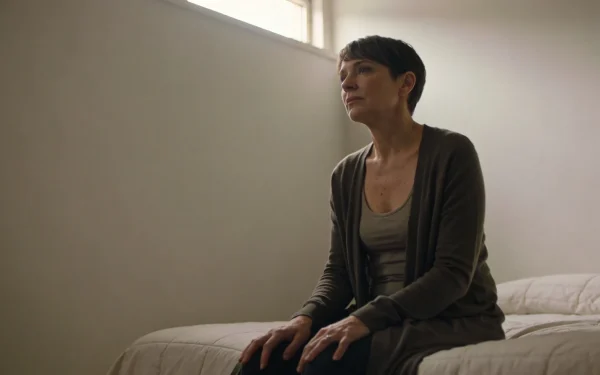

Written by Rytis & Violeta · Feeling Session founders · Updated May 2026
· 12 min read

If you searched this experience, you probably aren’t here for poetry. If you’re living with the dark night of the soul, your body already holds the answer your mind keeps circling. Something in your chest feels wrong. Maybe tight. Maybe hollow. Maybe both at once in a way that doesn’t make sense. Your life might look fine from the outside. But inside, you feel far from yourself—scared, numb, wired, or quietly desperate in a way you can’t explain to the people around you. That doesn’t mean you’re weak. It doesn’t mean you’re dramatic or failing at growth. It means you’ve entered a human threshold that many people walk into and very few know how to name honestly. By the end of this page, you’ll have a clear next step you can trust when tonight gets heavy again.
In the body, this can land as heaviness in the shoulders — your body has its own signal.
Here’s what I want you to hold at the start: this experience is often less random than it feels. There is usually a path forward. It becomes visible when the next steps are specific and small enough to actually do. That’s what this guide is for—how to understand what’s happening in you, how to tell a spiritual crisis from a spiritual emergency, and what to do tonight that creates real traction in your body, not just your mind.
If you want the full map, start with my comprehensive Dark Night guide and return here for this deeper piece.
Key Takeaways
- The body always knows before the mind does.
- Whatever you’re feeling: the body has been waiting for permission to feel it fully.
- “Why” matters less than where it lives in your chest, throat, jaw, or stomach.
- Stillness is the practice — not a mood, not a goal.
- One small thing today is enough.
When silence gets loud: what this actually is

Sometimes the loudest thing in the room is what stopped working inside you.
The dark night is often misread as punishment. Or spiritual failure. It’s usually neither. It’s a restructuring. The way you used to regulate, perform, believe, or hold yourself together is no longer holding. For many people, this starts right here: old strategies stop working before anything new has formed underneath.
Historically, the phrase comes from Christian mysticism—especially St. John of the Cross—where it described a loss of spiritual certainty before deeper union (Wikipedia overview). In lived, modern terms, it often looks more private and physical than that: chest pressure, existential fear, numbness, sudden grief, insomnia, loss of meaning, panic that you’re “losing yourself,” and a growing distrust of your own inner voice.
The subtle part matters. Sometimes this is a spiritual passage. Sometimes it’s a spiritual crisis braided with burnout, trauma activation, attachment pain, or nervous system overload. Sometimes it’s both at once. When everything gets labeled “awakening,” you can miss what your body is urgently asking for.
You might recognize this pattern. You can explain your process brilliantly—but still feel trapped. Practice sometimes spikes distress instead of easing it. Nights feel physically heavy or electrically charged. You keep asking why this is happening again.
Recurring waves are not evidence that you failed. They usually mean insight outpaced integration.
Memorable truth: You are not broken because it came back. You are being asked to live the work, not just understand it.
Why it keeps returning after retreats, books, and breakthroughs

If you’ve done the reading and the retreats and you’re still here—the problem isn’t effort. It’s the layer the effort is landing on.
Most people stuck here are not under-trying. They are over-straining in the wrong layer.
You gather insight. It helps for a while. Then insight hardens into identity, and everything gets tighter again. Over time, your language gets sharper while your contact with raw feeling gets thinner.
That’s the hidden trade-off.
Many people in this stage also struggle with ego vs intuition: the inner signal feels urgent and absolute, but acting on it still leaves you dysregulated. Urgency can be protection wearing intuitive language. It feels like truth. Your body still can’t settle from it.
Then bypassing becomes subtle and respectable. Not denial—optimization. Over-meditating to avoid anger. Over-reading to avoid grief. Staying in “witness mode” to avoid tenderness. If that pattern sounds familiar, spiritual bypassing signs can help you catch it sooner.
Underneath all this, your nervous system may still be braced for danger. Insight alone does not convince a vigilant body. This is why you can be spiritually articulate and physiologically panicked in the same hour. Public health sources like NIMH describe anxiety patterns that often overlap with dark-night symptoms, even when the experience also carries existential or spiritual depth.
People ask about dark night duration hoping for a timeline. A better question is: what keeps the cycle in motion? Duration is shaped less by what you know and more by whether you return to embodied contact consistently—not once, but as a way of living.
Memorable truth: Healing is rarely blocked by missing knowledge. It is blocked by missing contact.
The line between spiritual crisis and spiritual emergency
This is the question your body is really asking: Am I falling apart, or am I being taken apart so something truer can form?
The core fear beneath this search is precise: “Am I transforming, or am I collapsing?”
A spiritual crisis is disorienting—but it usually leaves enough ground for self-observation and basic function.
A spiritual emergency includes meaningful safety risk, severe functional impairment, or rapid loss of reliable grounding.
You can move between these states. They are not identity labels.
In crisis, you may feel dread, emotional flooding, meaning collapse, identity confusion, sensitivity spikes, and intense grief or numbness.
In emergency, you may be unable to care for basic needs for extended periods, lose reality testing, become dangerously impulsive, have active thoughts of harming yourself or others, or enter escalating agitation with severe insomnia.
If any risk of harm is present, do not interpret. Protect safety first. In the U.S., contact 988 Lifeline. Elsewhere, contact local emergency services now.
If you’re unsure where you are, use a plain 24-hour check. Can you eat, hydrate, sleep at least a little, and complete one basic responsibility? Can you separate fear from fact for at least a few minutes at a time? Can you ask for support without spiraling into total shutdown? When most answers are yes, you’re likely in crisis territory and need steady regulation. When most answers are no, treat it as emergency-level strain and get direct support now.
This is where people in this experience often get stuck: they either minimize signs of danger or over-interpret every hard sensation as disaster. Both reactions make the nervous system louder. What helps is a middle path—grounded in simple evidence from your day. Concrete markers. Not spiritual self-judgment.
A daily note can help. Write three lines at night: “What happened in my body today? What increased activation? What helped me return?” You can pair this with how to feel your feelings or nervous system regulation basics so your practice stays practical when your mind gets dramatic. If you feel disconnected from sensation, signs of emotional numbness can help you spot freeze states early. If your evenings spiral, keep a short grounding plan from how to ground when anxious open on your phone before bed. If inner work keeps intensifying symptoms, review when meditation feels overwhelming and reduce exposure until stability returns.
A grounded order of care is simple: safety, regulation, then meaning.
If shame appears—”needing practical help means I’m failing spiritually”—notice it, but don’t believe it. That’s a symptom, not a truth. Asking for support is not regression. It’s how stabilization begins.
If meditation currently makes symptoms worse, pacing—not worth—is often the issue. Why meditation can make you feel worse explains the mechanism. During this, pacing is often the difference between contact and overwhelm.
Memorable truth: Any spiritual path that ignores safety becomes avoidance dressed as depth.
If your body is carrying more than your mind can hold right now, Name the pattern — 3 free answers, no credit card — If this reached something in you, there’s a next step that doesn’t require figuring anything out first.
A body-first practice for tonight when your chest is tight
You don’t need to fix anything first. You just need ten minutes where you stop trying to figure yourself out.
You don’t need to be calm before you begin. You only need permission to stop solving yourself for ten minutes.
Start where you are. Scattered. Numb. On edge. That’s enough.
- Lie down on a flat surface.
- Place your hands beside your hips, palms facing down.
- Close your eyes and cover them with a T-shirt or scarf.
- Keep your body completely still. Do not sway, rock, stretch, or adjust unless needed for safety.
- Move your attention from thoughts into sensations.
- Find one body location with the strongest signal—tightness, pressure, ache, heat, cold, emptiness, buzzing, or heaviness.
- Stay with that exact spot for 10 minutes. No analysis. No fixing. No story about it.
- Each time your mind drifts, return gently to sensation in that one location.
Tolerance matters more than intensity here. If ten minutes is too much, do four. Keep the structure.
A quiet truth to hold while you practice: Sensation can be met before it is understood.
When the timer ends, don’t rush up. Keep your eyes closed for a few breaths. Notice one thing that shifted—even 2%. Then name one plain sentence out loud: “Right now, I feel _ in my _.”
That final naming step is integration. It teaches your system that contact is possible. And survivable.
What changes when this starts working
The first shift isn’t fireworks. It’s the moment your own inner weather stops feeling like an emergency.
The first change is rarely dramatic relief. It’s reduced panic about your own inner weather.
Then something subtler softens. The compulsion to decode every wave in real time. You still care about meaning—but meaning no longer replaces contact. Hard nights still come. They just stop feeling like proof that you’re back at zero.
Over weeks and months, recovery looks ordinary and profound at the same time. Shorter spirals. Less catastrophic interpretation. More pause before reaction. Less performative “spiritual” language. More honest sentences. Faster return to yourself after activation.
This is dark night recovery in real life. Not permanent bliss. Reliable return. For many people, this does not end with one breakthrough. It softens through repeated moments of honest contact.
What changed: you trust your ability to return.
What softened: fear, urgency, and self-attack.
What remains true: you still need daily contact, especially on hard days.
Keep these anchors close: stabilize before interpreting, choose small daily contact over heroic effort, and speak plain truth about what your body is carrying.
If you want to continue from here:
– How to feel your feelings when you feel numb
– Ego vs intuition when both voices sound convincing
– Dark night of the soul: complete guide
You don’t need a perfect belief system tonight. You need one honest moment of contact, repeated until trust becomes something your body can feel—not something your mind has to argue for.
You don’t have to fight this. But you can meet it—with honesty, with gentleness, and with one true next step that your body believes in.
When you’re ready, try Feeling.app free →
3 answers. 30 seconds each. No credit card. Yours to keep.
The Feeling Session is the body practice this work is built around.
Frequently Asked Questions
Why do you feel this even when you “know better”?
Because knowing and living are two different things in your body. You can understand your patterns with total clarity while your nervous system still carries the charge from what hasn’t been felt yet. That gap between insight and integration—it’s not a personal failing. It closes when understanding is paired with repeated, honest body contact.
How long does dark night duration usually last?
There’s no clean timeline. Many people experience waves over months rather than one single episode that starts and ends. Instead of counting days, track your capacity: less panic during hard stretches, faster recovery afterward, and less abandoning yourself when things get intense. Those are the real markers of movement.
Can a spiritual crisis and anxiety happen at the same time?
Yes. That overlap is more common than most people realize. Treating the experience as only spiritual or only clinical can miss key drivers on both sides. A combined, grounded approach—one that honors both your body and your inner life—is often safer and more effective during this experience.
Why does meditation sometimes make this worse?
Some meditation styles increase internal exposure faster than your system can absorb. It’s not that you’re doing it wrong. It’s that the dose is too high for where you are right now. If symptoms spike, reduce duration and intensity, and prioritize still, body-based contact practices where you stay with sensation rather than opening into vast space.
How do you know whether this is a spiritual emergency?
If your safety, basic functioning, or reliable sense of what’s real is significantly compromised, treat it as an emergency first. Get immediate support. Meaning-making comes after stabilization—not before, not instead.
What is one thing to do tonight if you feel on edge?
Lie down for 10 minutes with your hands beside your hips, palms down, eyes closed or covered, and body still. Find one strong sensation location and return to it each time thinking takes over. That’s it. One honest round is enough for tonight.
What is the dark night of the soul?
The dark night of the soul is a body-level experience, not just a thought pattern. It often shows up as chest tightness, shallow breathing, or a sense of heaviness — your nervous system responding to something it hasn’t fully processed. It is not a flaw. It is protection that outlived its purpose.
What causes the dark night of the soul?
The causes are rarely single events. The dark night of the soul typically builds from accumulated stress, relational patterns, unprocessed grief, or early environments where certain feelings were not safe to express. The body adapts, then the adaptation becomes the pattern.
A note on this work: The Feeling Session is a body-first emotional practice — not therapy, not medical care, and not a substitute for either. If you are in distress, dealing with severe symptoms, or unsure what you need, please reach out to a licensed mental-health professional. The information here reflects our lived experience guiding sessions; it is offered as support, not as diagnosis or treatment.