
Written by Rytis & Violeta · Feeling Session founders · Updated May 2026
· 11 min read

Something in your life stopped fitting, and you can feel it more than you can explain it. The advice you keep finding — follow your passion, trust the process, journal more — sounds fine and helps almost no one in the middle of real confusion.
Maybe you’re functioning on the outside and quietly unraveling on the inside. Maybe you keep asking the same question in different words: What am I missing? This is where people get stuck the longest — not because they’re broken, but because they’re trying to solve an emotional problem with generic answers.
Soul searching usually has a clearer path forward than it feels. Clarity starts not with a revelation, but when the right steps are named specifically enough to act on.
By the end of this, you’ll have one grounded step you can use today. Not someday.
Soul searching is not about inventing a new identity overnight. It’s about noticing where your current life and your inner truth stopped matching — then restoring connection one honest decision at a time.
Why soul searching starts when your old map stops working

Most people think soul searching begins with confusion. More often, it begins with mismatch.
Your life may still look fine on paper, but your body tells a different story: heavier mornings, quicker irritability, numbness in moments that used to matter, a low static tension that never fully turns off. The pain is rarely I don’t know who I am. It’s closer to the way I’m living no longer feels true, and I don’t know what to trust next.
This is why broad advice fails. “Follow your passion” sounds good and helps almost no one in the middle of real pressure, grief, debt, family roles, or emotional exhaustion. Soul searching needs more precision than inspiration.
Your mind often asks huge existential questions when it’s actually trying to solve a smaller, immediate contradiction. For example:
- You say your issue is “purpose,” but the immediate conflict is a relationship where you can’t be honest.
- You say your issue is “identity,” but the immediate conflict is chronic self-abandonment.
- You say your issue is “direction,” but the immediate conflict is burnout that makes every option feel equally wrong.
When people skip this step — naming the actual contradiction — they spiral. When they name it, movement starts.
I’ve sat in this exact loop. I thought I needed a life overhaul. What I actually needed was one truthful sentence: “I keep saying yes to avoid disappointing people, then I resent my own life.” That sentence changed my next week more than a year of abstract thinking ever did.
This is why soul searching can feel repetitive. You aren’t failing at insight. You’re circling a truth you haven’t made actionable yet.
Your old map is breaking because it can no longer carry who you are now. That is not a dead end. It is data.
The part most advice misses: your body is in the conversation

Soul searching sounds mental. The mechanism is embodied.
When your nervous system is overloaded, everything feels existential. You interpret ordinary uncertainty as total collapse. Under stress, the brain biases toward threat scanning, short-term safety, and repetitive loops — a pattern widely discussed in stress research from the APA and public health sources like MedlinePlus.
This matters because most people try to think their way clear while their body is signaling danger. That’s like trying to read a map while running.
There’s also a cognitive pattern called rumination: repetitive, self-focused thought that feels productive but actually increases distress without generating decisions. In practice, rumination sounds like inner analysis. In outcomes, it behaves like emotional paralysis.
A useful test is simple: reflection asks, “What matters here, and what is my next honest step?” Rumination keeps asking, “Why am I like this?” in different tones, with no endpoint. One opens movement. The other drains it.
One reader told me she spent months journaling every night and felt worse. When we looked closely, her pages were full of recursive self-judgment, not decision-oriented reflection. The shift was simple: each entry had to end with one concrete action for the next 24 hours. Within days, her writing started helping instead of draining.
The other piece is interoception — your ability to sense internal body signals like tightness, pressure, heat, hollowness, or breath changes, described in depth here. When this channel is ignored, soul searching stays abstract. When it’s included, insight becomes more accurate, because your body often detects misalignment before your mind can explain it.
That is why people often say, “I can’t explain it, but something feels wrong,” or “My chest tightens when I think about staying,” or “I feel relief when I imagine telling the truth.” Those are not dramatic lines. They are directional signals.
You don’t need to decode your whole life at once. You need to become trustworthy to yourself again — one signal and one choice at a time.
If this pattern is still sitting in your body right now, Write what you feel — 3 free answers, no sign-up — You don’t need the perfect words. One honest sentence is enough to start.
Why “finding yourself” gets stuck in loops — and how to break one today

The problem is not a lack of intelligence. It’s a trust fracture.
When this repeats, there is usually a break in one of three places. Sometimes you stop trusting your own signals, so you hand your truth to advice, trends, or louder voices around you. Sometimes you can name the pain but not what it points to, so every feeling starts to seem random. And sometimes you already know what is wrong, but one necessary conversation, boundary, or decision keeps getting postponed.
Most articles stop at insight. Real change starts when insight becomes behavior.
If clarity isn’t changing behavior, it isn’t clarity yet. It’s information.
That line can sting. But it can also be a relief, because it lowers the fantasy that one perfect realization will solve everything. A better question is quieter and more useful: what is the smallest honest action that proves you heard yourself?
This pattern becomes gentler when you stop asking “Who am I forever?” and start asking “What is true for me this week?” Long-horizon identity questions matter, but short-horizon truth creates traction. It might sound like this: “I need one evening this week without performing for anyone.” Or: “I’m not ready to decide my entire career, but I am ready to stop pretending this role is sustainable.” Or: “I can’t repair everything with my family right now, but I can stop speaking to myself like an enemy.”
You are not lost because you don’t have answers. You feel lost because your inner signals and outer choices stopped speaking to each other.
Restoring that conversation is what what you carry is actually for.
A 12-minute soul searching practice you can do tonight
Not a life plan. One reliable session that reduces noise and reveals your next step.
I use versions of this when I feel emotionally foggy. It works because it integrates mind, body, and decision instead of keeping them separate.
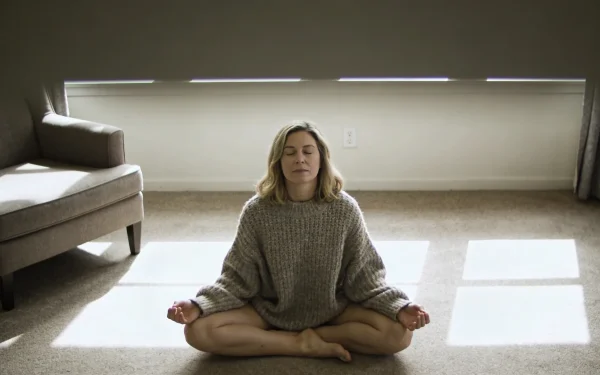
Set a timer for 12 minutes. Sit with both feet on the ground, body still. Place your hands on your thighs with palms facing down. Close your eyes or cover them gently. Keep your body still throughout.
Minute 0–2: Name the true question
Write one sentence that begins with:
“The thing I’m actually trying to understand is…”
Be concrete. Not “my life.” Something narrower: “whether I’m staying in work that is hurting me,” or “why I keep disappearing in relationships.”
Minute 2–4: Locate it in your body
Without changing posture, scan for the strongest sensation right now — throat pressure, chest weight, stomach drop, jaw tension, heat behind the eyes, numbness. Write:
“When I think about this, I feel it most in my ___.”
Don’t interpret yet. Just locate.
Minute 4–7: Separate facts from fear stories
Create two short columns:
- What I know is true right now
- What my fear is predicting
Example:
- True: “I dread Monday mornings consistently.”
- Fear: “If I change anything, I will ruin everything.”
This is often the turning point. Fear stories feel like facts until you set them side by side.
Minute 7–10: Choose one 24-hour action
Ask:
“What is one action in the next 24 hours that would make me more honest with myself?”
Keep it small and behavioral:
– Send one message
– Decline one commitment
– Ask one direct question
– Schedule one conversation
– Block one hour for quiet reflection
If your answer is “I don’t know,” use this fallback: write a three-sentence note to yourself naming what hurts, what you need, and what you will do tomorrow morning.
Minute 10–12: Close with one anchoring sentence
Write this exactly, then finish it:
“I don’t need my whole future solved tonight. I need to honor this next true step: ___.”
Open your eyes slowly. Stand up only when your breath feels steadier than when you started.
This practice is intentionally modest. It doesn’t promise a total breakthrough. It gives you something better: a trustworthy next move. Over time, these moves rebuild self-trust — which is the true engine beneath this pattern.
What shifts after one honest session
After a grounded session, most people don’t feel euphoric. They feel simpler.
The background noise drops from ten voices to two. You may still carry grief, fear, or uncertainty — but those feelings stop being shapeless. They become directional. That is emotional integration: not the absence of pain, but the return of coherence.
This is the moment most people underrate. They think, “I still don’t have the full answer.” But they’ve already crossed the real threshold. This pattern matures when you stop demanding total certainty and start practicing reliable connection.
Clarity is not a lightning bolt. It is a relationship with truth.
Your body often whispers the answer before your mind can explain it.
The next honest step is small enough to do and strong enough to change your direction.
Life will keep presenting new versions of this response because you keep evolving. That is not regression. It’s a recurring calibration between who you are becoming and how you are living now.
What makes the process worse: urgency, comparison, and self-contempt. What helps: specificity, embodied attention, and one committed action window — 24 hours is ideal.
If tonight’s action works, repeat the same 12-minute process tomorrow with one updated question. If it doesn’t work, reduce the size of the step rather than abandoning the process. Change rarely fails because you picked the wrong philosophy. It fails because the action was too large for your current nervous system capacity.
The path is often clearer than it feels. Not because life is easy, but because honest steps create evidence. Evidence creates trust. Trust creates momentum.
You came here looking for something you could trust. Keep it concrete tonight: one true question, one body signal, one 24-hour action. That is enough to move from confusion toward relief — and from relief toward confidence.
When you’re ready, try Feeling.app free →
3 answers. 30 seconds each. No credit card. Yours to keep.
Pause here. Lie down or sit with feet flat on the floor. Let your hands rest beside your body, palms facing down. Close your eyes. Breathe into the tightest place. Notice where in your body you feel what you just read. Stay there for thirty seconds. That contact is already the practice.
When this becomes more spiritual than emotional, somatic release is the next honest read.
The Feeling Session is the body practice this work is built around.
Frequently Asked Questions
Why does soul searching keep coming back even after I thought I figured things out?
Because you’re not solving a one-time puzzle. You’re adjusting to new life conditions. Each major change — in work, relationships, health, identity — can create a new mismatch between your inner truth and outer choices. The process returns in cycles because you keep growing.
How do I know if I’m soul searching or just overthinking?
Ask whether your reflection leads to one concrete action. If it does, you’re in constructive territory. If you stay in repetitive analysis with no behavioral shift — same questions, same loops, no movement — it’s likely overthinking. The body test helps too: reflection usually brings some relief. Overthinking leaves you more tense than when you started.
Why do I feel this so strongly in my body?
Because emotional processing is embodied, not only mental. Tight chest, stomach knots, throat pressure, and numbness are meaningful signals that something important is misaligned. Under prolonged stress, the body often registers truth before the mind can articulate it.
What should I do first when everything feels unclear?
Narrow the question to one immediate contradiction and choose one 24-hour action. Clarity grows faster from specific movement than from global life analysis. If even that feels too much, start with the fallback from the practice above: write three sentences naming what hurts, what you need, and one thing you’ll do tomorrow morning.
Can soul searching help if my issue is mostly about relationships or work?
Often that’s where it’s most useful. What you carry reveals where you’re performing, suppressing, or abandoning yourself — and those patterns show up most visibly in relationships and work. Better decisions in both usually follow once the pattern is named clearly.
How long should I keep soul searching before making a decision?
Set a short window: 7 to 14 days of daily reflection plus concrete actions. If the same truth repeats and your body consistently reacts the same way, that repetition is your decision signal — not a reason to delay further.
What is soul searching?
This experience is a body-level experience, not just a thought pattern. It often shows up as a racing heart, tense shoulders, or a persistent sense of unease — your nervous system responding to something it hasn’t fully processed. It is not a flaw. It is protection that outlived its purpose.
What causes soul searching?
The causes are rarely single events. This typically builds from accumulated stress, relational patterns, unprocessed grief, or early environments where certain feelings were not safe to express. The body adapts, then the adaptation becomes the pattern.
A note on this work: The Feeling Session is a body-first emotional practice — not therapy, not medical care, and not a substitute for either. If you are in distress, dealing with severe symptoms, or unsure what you need, please reach out to a licensed mental-health professional. The information here reflects our lived experience guiding sessions; it is offered as support, not as diagnosis or treatment.