
Written by Rytis & Violeta · Feeling Session founders · Updated May 2026
· 17 min read

TL;DR: How to let go of someone isn’t a single decision — it’s the body un-bonding from a person it had organized itself around. The mind decided weeks ago. The body is still loving them. Letting go happens when you stop fighting the missing and let it complete in stillness.
How to let go of someone is the body’s slow un-bonding from a person it had organized its safety, sleep, and breath around. It is not one decision. It is the nervous system releasing a connection layer by layer, in sensations — chest pressure, throat closing, hands that still reach across the sheet — until the missing finally has somewhere to go that isn’t them.
The Mind Decided. The Body Is Still Loving Them.

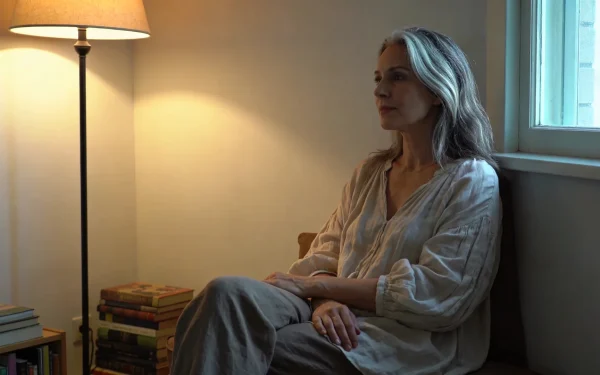
It’s 3:14 a.m.
You know without looking. The bed is too wide on their side. The pillow still smells like them, or you imagine it does, which has the same weight in the body. You went no contact two months ago. You journaled. You filled the calendar so there were no empty hours. You read three articles called 7 Steps to Move On, tried steps one through seven, and you are still here, awake, with your hand on the cold half of the sheet.
The mind made the decision a long time ago. You have explained it to yourself a hundred times — why it had to end, what they did, what you did, how the version of them you loved wasn’t the version of them you lived with. The mind has its case file. It is airtight. It wins every internal argument before sunrise.
And still — the body is still loving them.
That is what is happening at 3 a.m. Not weakness. Not regression. Not “you haven’t accepted it yet.” Your body bonded to a person. Your nervous system organized its safety, sleep, the rhythm of its breath around them. The bond did not get the memo when the relationship ended. It is a slow, somatic structure, and it lets go on its own timeline.
If you came here typing how to let go of someone — that’s why nothing has worked. You have been trying to let go with the part of you that already let go. The body is in a different room. It has not decided anything.
This is going to be a different kind of help. Not a list of steps. Not a countdown. Just a slow walk into the body where the bond actually lives.
If tonight has crossed into I would rather not exist than miss them this much, pause here. That thought is grief through a body in extreme distress. Scroll to the bottom and use one of the crisis lines — 988 in the US, 116 123 in the UK and Ireland. Reaching out interrupts the loop. The article will still be here when you come back.
Key Takeaways
- Letting go isn’t a decision the mind makes once. It’s the body releasing a bond it had built around someone — on its own timeline.
- No contact, journaling, and “stay busy” haven’t worked because none of them speak to the place where the bond actually lives.
- The bond lives in the chest, the throat, the stomach, the hands that still reach in sleep, the lower back that won’t soften at night.
- Trying to let go faster makes the body grip harder. Letting the body feel the missing — without rescuing it — is what un-grips.
- There is the part of you that misses them, and there is the part of you watching the missing. The second part is the way through.
- Some sensations have to complete in stillness before they release. The body works the way a dentist works: you don’t leave halfway.
- You will not “get over it.” You will, slowly, become someone who can carry this without being run by it.
What the Body Actually Bonded To

When you think you’re holding onto a person, look closer. You’re holding onto a body memory.
The rhythm of their breath next to yours at 4 a.m. The shape of their weight on the other side of the mattress. The way your shoulders dropped a half inch the second you heard their key in the door. None of that lived in the mind. All of that lived in the nervous system.
When they leave, you lose the version of your own body that lived inside that connection. The shoulders that knew how to come down. The chest that knew it was safe. The stomach that didn’t have to brace. The hands that reached for someone and got reached back for. The body learned a specific shape with this person. The shape outlived the relationship.
That’s why the missing is so physical. The chest aches because it expected pressure that isn’t there. The throat closes because words have nowhere to go. The hands are restless because they learned a job — touching this person — and the job ended without warning. The lower back stays tight because some old part of the spine is still listening for a second body to settle the bed.
The body is doing what it learned to do, which was to bond. And the bond is asking, every night, where did the other half of this go?
If the relationship sat on top of an older wound — a parent who left, a childhood where safety was never reliable — the un-bonding is doubled. You are losing them, and also losing the chance to repair the older loss this person was supposed to repair. That second layer is what makes some breakups feel categorically larger than the relationship itself. The deeper version of this work is held by the fear of abandonment wound underneath.
The question is not how do I stop missing them? It is what is my body still organized around, and how does it re-organize?
Trying to Let Go vs. Letting the Body Release

Most of what you have been doing for two months has been trying to let go. That is a mental project. Letting the body release is the opposite of a project. From the outside it looks like nothing is happening; inside the body, the work is enormous.
| Trying to let go (mind’s project) | Letting the body release |
|---|---|
| Deciding it’s over again at 3 a.m. | Letting the chest stay heavy without needing a reason |
| Going no contact and counting the days | Lying down when the missing arrives, eyes covered, body still |
| Re-reading old messages for evidence | Putting the phone in another room for ten minutes |
| Listing every red flag from the relationship | Naming where the ache lives in the body right now |
| Forcing yourself to stop crying | Letting the throat close, then letting it open on its own |
| Performing healed in front of friends | Saying, quietly, “I am still loving them, and that is true” |
| Filling the bed with anyone else | Sleeping on your back, palms down, alone, for one night |
The left column makes the bond grip harder. Every action there tells the body: the missing is dangerous, don’t have it. The body hears threat, threat means brace, bracing means hold. The bond stays exactly where it is.
The right column is the opposite message: the missing is allowed. We are just going to be here together. The body, met that way, finally relaxes its grip — not because you forced it, but because it stopped having to fight you about whether the missing was permitted.
Two questions. Don’t answer with the head. Let the chest answer.
Where in your body do you still keep them? Throat? Sternum? The hollow under the ribs? The hands?
If you stopped trying to let go this week — if you let yourself just miss them, fully — what would soften?
If you want this practice in your pocket, Feeling.app is the home of the method. Free to begin.
Why “Just Move On” Made It Worse
The advice everyone gave you — stay busy, date someone new, give it time — was well-meaning and mostly useless. Every one of those instructions told the body the same thing: the missing is the problem; cover it.
So you covered it. You dated. You worked late. You ran until your hands shook. You posted three things that looked like a person who was fine. Then you came home, sat on the edge of the bed, and everything you had spent the day burying came out at once.
That’s not failure. That’s the body refusing to be lied to.
The bond does not get smaller when you cover it. It gets compressed. Compressed grief lives in the lower back, the jaw, the place between the shoulder blades. It comes out as insomnia, as the way you cry in the car, as the way you push the next person away before they can leave you — the shape that becomes why do I push people away in the next relationship. Unfelt grief becomes the architecture of the next love.
This is also why no contact keeps half-working. It stops adding new bond. What it doesn’t do is release the bond already there. Six months of clean no contact with no body work is six months of the same un-felt missing, frozen in place. The bond does not weaken from time alone. It weakens from being met.
Missing them does not mean you should go back. Missing is grief, not signal. The size of the missing is the size of the bond — not the rightness. This is the same body process underneath the stages of grief breakup — denial, anger, bargaining, depression, and the slow, quiet acceptance that doesn’t feel like acceptance from inside it. You are not broken. You are bereaved.
The Part of You Watching the Missing
This is the hinge of the whole thing.
You just read the section above. Maybe your chest tightened. Maybe a memory rose — a specific morning, a specific way they used to say your name. Maybe the throat closed.
Now notice something almost no one points at.
There is the part of you that is missing them.
And there is the part of you that just noticed the part of you that is missing them.
Those are not the same.
The first part is the bond. The chest reaching, the hands restless, the stomach hollow, the small story the mind keeps writing about whether they think of you, too. That part feels like you — because it has been so loud for so long it has worn the shape of your name.
The second part is the noticer. The watcher. The one who just heard the missing rise without becoming the missing. That part is also you — the deeper one, who was here before this relationship began, who was here on the morning they left, and is still here now, reading these words.
That watcher is not missing them. The watcher is the part of you that can sit with the missing without dissolving into it — the proof that you can love someone, lose them, and not vanish along with the love.
This is what the method calls the two levels. The human level — the bond, the 3 a.m. ache, the pillow you are still smelling. And the observer level — the watcher, completely intact, who can hold the bond without becoming it. You can watch a chest tighten without becoming the chest tightening. The watching does not fight the missing. It does not rush it. It just stays. The staying is what lets the body release.
I have watched people, lying still on the mat in Plateliai, find this watcher for the first time after years of trying to do the right thing about a breakup. The chest that has been gripping for a year unhooks something it didn’t know it was holding. They just exhale, longer than they have exhaled in months.
You are not the bond. You are the one who watches the bond. And the one who watches has been here the whole time, waiting for you to turn around.
A Full Feeling Session for the Un-Bonding
Letting go of a person you bonded to is deep work, and deep work needs the deep practice. This is The Feeling Session. A shorter, sit-up Short Body Reset exists for when a wave hits you mid-workday. For tonight, you want this one.
Lie on your back. Bed, mat, or floor. The whole body supported by the ground.
Palms down, beside your hips. Arms relaxed and straight along your sides. Not on the chest. Not crossed. Not folded. Not on the belly. Not palms up. Just palms down beside your body, the way the body lies when it has nothing to hold.
Cover your eyes. A scarf, a soft T-shirt, a cloth folded like a compress. Eyes closed underneath. The dark moves the attention inward, where the bond lives.
The body does not move. Full stillness. Even when the legs want to shift. Even when the throat wants to swallow it down. The stillness is the dentist’s chair — you don’t leave halfway through. You stay until the work completes.
Nothing on your body. No phone on the chest. No cat. No weighted blanket. No hand. The body is fully open and free. Nothing to manage. Nothing to hold up.
Let them rise. Their face. Their voice. The morning of the last fight. The first time. Don’t follow the story. Notice where in the body each memory lands. Stay with the sensation, not the scene. Chest. Throat. Sternum. Stomach. Hands.
Stay until the wave completes. Not until the missing is gone — that is a different timeline. Until this particular wave moves, peaks, and softens into something quieter. Usually 30 to 90 minutes. The body decides, not the clock.
When you finish, move slowly. Don’t pick up the phone. Drink water. Be quiet. Something in the bond just got met.
You will need to do this more than once. The bond did not form in one night and does not release in one night. Each cycle — meet, feel, soften — a thin layer comes off.
When you are ready, try Feeling.app free →
3 answers. 30 seconds each. No credit card. Yours to keep.
One Small Thing Tonight
You are not going to be done in one night. The bond is older than this article and bigger than tonight’s bed. Nothing they do or don’t do tomorrow can change what your body is slowly releasing tonight.
So here is the one small thing.
The next time the missing arrives — probably this week — pause for one breath before you reach for the phone, the photo, the playlist, the scroll.
One breath. Long exhale. Then ask the chest one quiet question. Where in the body am I missing them right now?
Don’t fix it. Just answer, in the body. Heavy chest. Closed throat. Cold hands. Hollow stomach. Tight shoulders. Heat behind the eyes. A weight in the lower back I didn’t notice all day. The body is the compass — it points to where the missing lives before the mind has language for it.
That naming is the watcher arriving in the present-day reach, saying — without words — I see this. I’m not making it stop. I’m just here with you while it moves.
Over weeks, that breath becomes a half-second of choice between reaching and staying. Over a year, the bond is still in the body — but you are no longer ridden by it. You are the one watching it.
This same body release runs through letting go of someone you love — the love does not disappear, it changes address. It lives when the bond tangles with anxious attachment, becomes a loop after how to stop overthinking after being cheated on, or turns into the ache of feeling alone in a relationship you are no longer in. Different shapes. Same address in the body.
You are allowed to still love them. You are allowed to miss them at the size you actually miss them. You are allowed to sleep on their side of the bed for one more week. None of that is failure. It is the body, un-bonding the only way it knows how.
Lie down with palms down. You stayed.
What Someone Said After the Session
I came in still in love with him a year after he left. I expected to cry. I didn’t. I just lay there. Forty minutes in, the chest opened in a way it had not opened since before I met him. Nothing changed in my mind about him. Something changed in the body about me.
— Feeling Session participant, Plateliai
Frequently Asked Questions
How do I let go of someone I still love?
Not by stopping the love. The love is allowed to stay. What changes is where it lives — from reaching outward to settling inward. Lie down, palms down, eyes covered, body still. Notice where the love lands — chest, sternum, throat, hands. Stay with that sensation without trying to release it. Each time you do, a thin layer of the bond softens. The love stays. The grip releases.
How long does it take to let go of someone?
As long as the body needs. Some release a ten-year bond in months of slow body practice. Some carry a six-month relationship for two years because it touched something older. The timeline is set by the depth of the bond, not the length of the relationship. Usually longer than you want, shorter than you fear.
Is it possible to let go of someone you can’t stop thinking about?
Yes — but not by stopping the thinking. The thoughts are powered by an unmet feeling in the body. When the chest, throat, and stomach finally get felt fully, the charge underneath the thoughts depletes. They quiet on their own. Stop fighting the thoughts. Meet the feeling underneath.
Why does my body still miss them after I decided to let go?
Because the bond did not live in the part of you that decided. It lives in the nervous system, in the muscles, in the rhythm your body learned to fall asleep to. Decisions are made in the mind. Bonds release in the body. The mind moves on in an afternoon. The body needs repeated meetings with the missing — in stillness.
Is no contact necessary to let go of someone?
For most people, yes. Not as punishment, but for a body reason: every contact adds new bond. Every text, every story view, every “just checking in” reactivates the pattern you are trying to release. No new contact stops the wound from being re-opened. It does not close the wound — body practice does that.
Should I be friends with them after letting go?
Possibly, but almost never right away. The body needs time to release the romantic bond before it can hold a different kind of connection without confusion. If you try while the body is still reaching, the friendship becomes a thinner version of the relationship and the bond never releases. Most who become real friends with an ex did so a year or more later.
What if I’ll never love anyone like this again?
You won’t. You will not love anyone the same way, because love is shaped by the specific person and the specific time in your life. You will love differently. Maybe smaller. Maybe larger. Maybe with more peace and less fire. The fear that this was your one chance is grief making the case for why it shouldn’t have to release.
Is letting go the same as forgetting?
No. You will remember them — specific mornings, specific phrases, the way the light fell across the kitchen on a particular afternoon. What changes is the body’s response. Right now, remembering tightens the chest, closes the throat, drops the stomach. After the bond has released, the same memory arrives quieter — a tenderness instead of an alarm. You remember. You don’t reach.
Why does letting go physically hurt?
Because a bond is a real, somatic structure, and dismantling a structure is felt in the body. The chest aches because it is releasing pressure it had organized around someone. The throat closes because words have nowhere to go. The stomach hollows because the body is processing loss biologically. The pain is not pathology. It is the bond, dissolving, in the place it was built.
How do I know I’ve actually let go?
You think of them and the body is quiet. Not absent — quiet. The throat does not close. The hands do not reach. You can wish them well and mean it. You will know because some morning the bed is just a bed again, and you slept through the night.
A note on this work: The Feeling Session is a body-first emotional practice — not therapy, not medical care, and not a substitute for either. If you are in distress, dealing with severe symptoms, or unsure what you need, please reach out to a licensed mental-health professional. The information here reflects our lived experience guiding sessions; it is offered as support, not as diagnosis or treatment.
What is the 3 6 9 rule?
It usually means your body is holding something the mind doesn’t yet have words for. Try one small thing today: lie down for ten minutes, palms beside your hips, eyes covered, body still. See what rises.
How to emotionally detach from someone?
Less by doing, more by stopping. The work is letting the body do what it already knows how to do, given enough stillness. Notice where you feel it — chest, throat, stomach, jaw. The body signals first; the mind interprets after.