
Written by Rytis & Violeta · Feeling Session founders · Updated May 2026
· 10 min read

If you’re searching this experience, you’re likely already in the worst part of it: your chest feels wrong, your mind is scanning for danger, and every breath starts to feel like a test you could fail. Part of you is afraid something serious is being missed. Another part is tired of feeling scared and second-guessing yourself all day. That push-pull is exhausting.
When breathing feels dangerous, the fear is real even when the danger is not.
You are not making this up. You are not weak. You are in a nervous-system loop that can feel intense, fast, and convincing. This page gives you a clear way through it: screen for red flags, read the pattern, then steady your body so fear does not make the whole decision. That is this experience without ignoring real medical risk.
You do not need perfect certainty to get safer; you need one reliable sequence when fear gets loud.
When that sequence is clear, you stop spiraling between “I’m overreacting” and “What if I wait too long.”
Why this feels terrifying so fast

Breath sensations are uniquely hard to ignore. A tense shoulder can fade into the background. Breathing cannot.
So when one inhale feels off, your threat system can escalate in seconds.
Then a painful loop starts: you check your breath, checking makes breathing feel less automatic, “less automatic” gets read as danger, danger raises arousal, and arousal changes breathing again.
This is why anxiety shortness of breath feels so convincing. It is real sensation plus catastrophic meaning fused together. Even mild overbreathing can create air hunger, chest tightness, dizziness, tingling, and unreality sensations—symptoms that feel medically alarming even when panic physiology is driving most of the spike (NIMH on panic symptoms, APA on anxiety).
Your body is not faking. It is overprotecting.
How to tell if shortness of breath is from anxiety (without missing danger)

In the moment, the goal is not a perfect diagnosis. The goal is a safe decision you can trust under pressure. If you keep wondering this experience, start with immediate safety, then look at pattern.
Shortness of breath is more likely anxiety-related when several clues line up at once:
- It starts around stress, conflict, anticipation, overstimulation, or sudden worry.
- It shifts with attention and settles somewhat when your body settles.
- It comes with panic features (racing heart, trembling, tingling, dread, unreality, urge to escape).
- It fluctuates quickly rather than steadily worsening hour by hour.
- You’ve had similar episodes in similar emotional contexts.
- You can usually speak full sentences, even if breathing feels unsatisfying.
Seek urgent medical care now if any red flags are present:
- New severe chest pain/pressure, or pain spreading to jaw, arm, or back
- Fainting, confusion, blue lips, or severe weakness
- Coughing blood, high fever, or sudden one-sided leg swelling
- Breathing trouble after allergic exposure with swelling or wheeze
- Persistently low oxygen saturation on a reliable oximeter
- Symptoms that are new, intense, and clearly unlike your usual pattern
Anxiety and medical illness can coexist. One does not cancel the other.
The safest approach is simple: rule out danger first, then read the anxiety pattern with a steady mind and a steady body.
Use it while symptoms are active so you can respond in real time.
A 10-minute body-first check during an episode
When fear spikes, complexity fails. Use this exactly for now.
This is not about forcing calm. It is about getting your footing back.
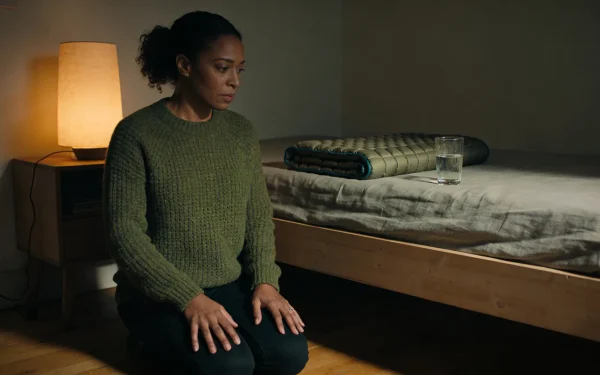
Settle in and give yourself permission
Sit with both feet on the floor.
Place your hands on your thighs, palms facing down.
Keep your body still.
Close your eyes.
Say silently: “I am allowed to check this slowly.”
Run the safety screen
Ask yourself:
- Do I have red-flag symptoms right now?
- Is this clearly different from my usual anxiety pattern?
- Am I worsening quickly in a way that feels medically unsafe?
If yes to any, seek urgent care.
If no, continue.
Quiet truth: screening is not panic—it is care.
Ease the rhythm instead of chasing a big inhale
Do not force a giant rescue breath. Use this rhythm and keep it gentle:
- Inhale through your nose for about 4 seconds
- Exhale through your mouth for about 6 seconds
- Keep each breath low and unforced
- Continue for 8–10 rounds
If counting adds pressure, use one cue: smaller inhale, longer exhale.
Notice where fear lives in your body
Keep eyes closed, palms down, body still.
Notice where breathing fear lives most right now: throat, upper chest, sternum, ribs, belly.
Rate three markers (0–10):
- Chest tightness
- Air hunger
- Urge to monitor every breath
Continue the same rhythm one more minute, then rate again.
Even a one-point drop matters. You are building tolerance and trust, not chasing perfect relief.
Name what came before the spike
Ask: “What happened just before this?”
Keep it concrete. A message. A deadline. An argument. A memory. A lonely hour. A thought like I can’t handle this.
Breath spikes are often stress signals before they become words.
If emotions feel stuck under the spike, why can’t I cry can help you name what your body is holding.
Close the loop with one next action
Choose one action only:
- Drink water slowly
- Step outside and keep longer exhales for 2 minutes
- Text one trusted person: “Breathing spike. I’m using my plan.”
- Write four lines: trigger, body signal, fear story, what helped by 1%
One next action closes the loop. Panic feeds on indecision.
If the anxiety is still sitting in your body right now, Write one true thing — 3 free answers, no sign-up needed — If something in this article landed, your body is already pointing somewhere. You don’t need to have it figured out.
What just changed if you completed that
You may not feel fully calm. That is not failure.
What changed is more important: you moved from helpless monitoring to an organized response your body can repeat.
Usually three things soften first:
- the urgency to keep testing your breath,
- the belief that every sensation equals immediate catastrophe,
- the feeling of being trapped and alone inside the episode.
And one truth stays steady: symptoms can still feel intense, but intensity is not the same as danger.
That distinction is where confidence starts to return.
Why episodes keep returning (and how to reduce them)
After one frightening episode, your system often starts pre-scanning. You check your chest while walking. You avoid exertion. You treat any sensation increase as proof of risk. That can protect in the short term, but it sensitizes in the long term.
The cycle is usually maintained by a few repeating patterns:
- Catastrophic interpretation (“This means collapse”)
- Repeated breath-testing
- Ignoring context (sleep debt, caffeine, conflict, overload)
- Shame after episodes (“I should be over this”)
That shame piece matters. A shamed body tightens, and a tighter body breathes less freely.
This is why people keep returning to this experience: body memory of old fear can make each new sensation feel like a fresh emergency.
Daily shifts that help most:
- Practice 2–3 minutes of gentle rhythm breathing while calm
- Reintroduce mildly avoided activity gradually
- Reduce late-day stress load when possible
- Keep short pattern notes for clarity, not obsession
A 14-day clarity plan so you stop starting from zero
Use this as rehearsal, not performance. The aim is familiarity, so your response feels available when fear rises.
Days 1–3: Map conditions
Twice daily, note stress (0–10), breath ease (0–10), and one context factor such as sleep, caffeine, conflict, workload, or loneliness. You are building pattern memory, not grading yourself.
Days 4–6: Rehearse when calm
Run the full 10-minute check once daily outside distress. What you practice in quiet moments becomes easier to reach in loud moments.
Days 7–9: Add gentle exposure
Choose one mildly avoided activity, such as a 10-minute walk. If sensations rise, return to smaller inhale, longer exhale and keep your body still while your nervous system settles.
Days 10–12: Train interpretation precision
Write three lines during symptoms:
- Sensation: tight chest, air hunger
- Fear story: “I might stop breathing”
- Balanced line: “This matches my anxiety pattern; I’m running my check.”
This is often where learning this experience starts to hold under stress, not only in hindsight.
Days 13–14: Build your personal protocol
Review notes and answer:
- What usually triggers me?
- What helps fastest, even by 10%?
- Which red flags are consistently absent?
- What do I do first next time?
Save your protocol where panic cannot hide it (lock screen, bedside card, wallet).
Keep it simple: one check-in when symptoms rise, one grounded action after.
What to do next, starting today
You may still feel scared in the moment. That does not mean you are failing, and it does not mean you are unsafe. Keep returning to the same sequence: screen red flags, read the pattern, regulate your body, take one grounded action. You do not need perfect certainty to get safer; you need one reliable sequence when fear gets loud. Keep that line where panic can’t argue with it.
And keep this one close too: When breathing feels dangerous, the fear is real even when the danger is not. When you remember that truth, you stop fighting yourself and start caring for yourself more precisely. That shift is often the first real relief.
You do not have to fight this experience by force, but you can meet it with honesty, gentleness, and one true next step.
You do not have to fight this experience by force, but you can meet it with honesty, gentleness, and one true next step.
When you’re ready, try Feeling.app free →
3 answers. 30 seconds each. No credit card. Yours to keep.
The Feeling Session is the body practice this work is built around.
Frequently Asked Questions
Why does my breathing feel manual when I get anxious?
Threat focus pulls breathing into conscious control. The more you monitor each inhale, the less automatic it feels. Gentle rhythm breathing and reducing breath-checking usually restore automatic flow.
Can anxiety shortness of breath last for days?
Yes, especially when stress remains high and monitoring stays constant. It usually fluctuates rather than worsening in a straight line. Persistent or new breathlessness still deserves medical evaluation, especially if red flags appear.
How do I know I’m not missing something serious?
Use a two-step filter: red flags first, pattern recognition second. If red flags are present or this episode is clearly unlike your usual pattern, seek urgent care. If red flags are absent and symptoms shift with regulation, anxiety is a more likely contributor.
Is it normal to yawn or sigh a lot during anxiety breathing episodes?
Yes. Frequent yawning and sighing commonly appear with air hunger and hypervigilant breathing. It can feel like low oxygen even when oxygen is normal. Longer, gentler exhales usually help more than repeated deep breaths.
Should I use a pulse oximeter at home?
It can be useful if used sparingly. Overchecking often reinforces anxiety loops. If you use one, check once, record it, then put it away. Normal readings with strong fear sensations are common in anxiety episodes.
What if I know it’s anxiety but still panic every time?
That is common. Cognitive insight alone often cannot override a sensitized nervous system. Repetition of one structured protocol—especially during calm—builds access during spikes. Consistency changes outcomes.
What is how to tell if shortness of breath is from anxiety?
This experience is a body-level experience, not just a thought pattern. It often shows up as restlessness, jaw clenching, or a feeling of being stuck — your nervous system responding to something it hasn’t fully processed. It is not a flaw. It is protection that outlived its purpose.
What causes how to tell if shortness of breath is from anxiety?
The causes are rarely single events. This typically builds from accumulated stress, relational patterns, unprocessed grief, or early environments where certain feelings were not safe to express. The body adapts, then the adaptation becomes the pattern.
A note on this work: The Feeling Session is a body-first emotional practice — not therapy, not medical care, and not a substitute for either. If you are in distress, dealing with severe symptoms, or unsure what you need, please reach out to a licensed mental-health professional. The information here reflects our lived experience guiding sessions; it is offered as support, not as diagnosis or treatment.