
Written by Rytis & Violeta · Feeling Session founders · Updated May 2026
· 9 min read

You searched for a this because you need something you can trust in a hard moment, not a soothing voice that sounds good for two minutes and then leaves you stranded. By the end of this page, you’ll know exactly what to do when your body gets loud, and the panic layered on top of sensation will start to soften.
When your chest is tight and your mind is racing, the hardest part is often feeling alone inside your own body.
If other scripts made you more anxious, distracted, or numb, that is not a personal failure. It is usually a pacing mismatch.
Most scripts quietly assume your body is already halfway calm. On a hard day, that assumption breaks the practice. You try to follow along, your chest tightens, your thoughts get louder, and then shame arrives: Why can’t I even do this simple thing?
The core truth is this: your body is not refusing you; your body is protecting you.
Once you work with that instead of against it, the next steps get much clearer.
On this page, you’ll get one this built for overwhelm, one 3-minute version for rough moments, and a clear way to measure progress you can trust.
Key Takeaways
- The body always knows before the mind does.
- Whatever you’re feeling: the body has been waiting for permission to feel it fully.
- “Why” matters less than where it lives in your chest, throat, jaw, or stomach.
- Stillness is the practice — not a mood, not a goal.
- One small thing today is enough.
Why you keep searching for a body scan script that actually helps

You are not looking for meditation theory. You are trying to solve a practical problem: What can I do when my system is loud and I still need to function?
That urgency is valid. It also creates a real trade-off. You want relief quickly, but your nervous system prioritizes safety before release. If a script pushes intensity too fast, attention collapses into effort. If it is too vague, you cannot anchor at all.
What helps in real life is simpler than most advice suggests:
Start narrow.. Stay concrete.. Let “neutral” count.. Stop treating calm as the only success state..
Body scanning is an interoceptive practice, meaning it trains your ability to notice internal signals (Interoception on Wikipedia). Evidence suggests mindfulness can support regulation, but pacing and consistency usually matter more than intensity (NCCIH on mindfulness and meditation).
You are not trying to win against your body. You are rebuilding contact with it.
The body scan script to use when you’re overwhelmed

Use this exact script for seven days before judging it. Record it once in your own voice, or read it live. A steady tone is enough.
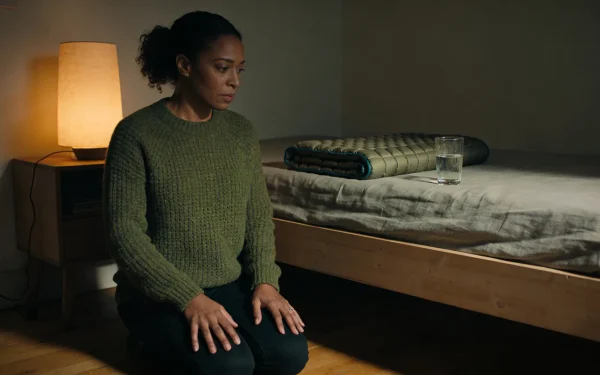
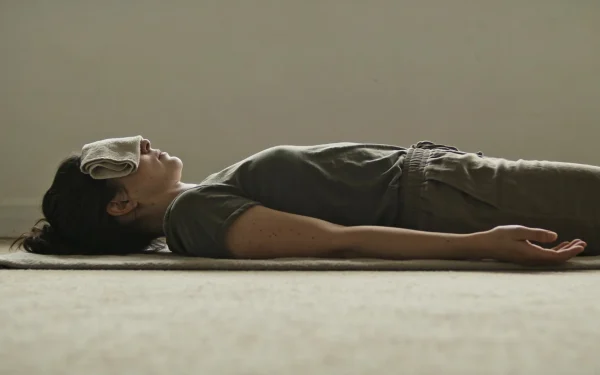
Set-up (non-negotiable): Sit or lie down in a position you can keep still. Place both hands palms down on your thighs or by your sides. Close your eyes or cover them gently.
10-minute body scan script (overwhelm-safe)
Take one natural inhale.
Take one longer exhale.
Nothing to fix. Only notice.
Start with contact points.
Feet with floor.
Legs with chair or bed.
Back with support.
Hands palms down.
Now bring attention to one foot only.
Toes, sole, heel, ankle.
Name one sensation: warm, cool, pressure, tingling, numb, neutral, tight, pulsing.
No perfect word needed. Close is enough.
Move to the other foot.
Same pace.
If your mind drifts, return to heel or sole.
Scan lower legs.
Shins, calves, skin contact, pressure.
Scan knees and thighs.
If numb, say “numb.”
If intense, widen to include both thighs and the surface under them.
Scan pelvis and hips.
Notice weight and support.
No story required.
Bring attention to lower belly.
If breath feels restricted, do not force depth.
Notice one inhale movement, one exhale movement.
Bring attention to chest.
If chest focus spikes anxiety, move to edges: side ribs, collarbones, upper back.
You can scan around intensity.
Scan lower back, upper back, shoulders.
On one exhale, allow 5% less effort in shoulders.
Bring attention to hands, still palms down.
Fingers, knuckles, wrists.
Scan forearms, elbows, upper arms.
Bring attention to jaw, mouth, cheeks, eyes, forehead.
If unclenching is possible, soften slightly.
If not, notice the clench respectfully.
Hold whole-body awareness for ten seconds.
One body. Many signals. No correction needed.
Name three neutral facts:
“I am in this room.”
“My body is supported.”
“This moment will pass.”
Keep eyes closed or covered for one more breath.
Then open slowly.
This this works because it gives your attention structure without forcing your body to perform calm. It builds tolerance first. Calm often follows later.
If this is still sitting in your body right now, Write one true thing — 3 free answers, no sign-up needed — If you felt something shift while reading this, that’s not nothing. That’s your body recognizing something your mind has been circling.
Why many body scan scripts fail (and why that is not your fault)

When stress is high, inward attention can feel like turning up the volume on an alarm. That response is common, especially under chronic strain, where sleep, focus, and arousal are already taxed (CDC on stress and coping, MedlinePlus on anxiety).
Most scripts miss this in predictable ways. They move too quickly through body regions, use abstract language when your system needs concrete cues, and frame success as deep relaxation instead of steady contact.
The result is discouraging: you follow instructions, feel worse, and assume you are doing it wrong.
Usually, the instructions were wrong for your state.
Early progress is smaller and more honest:
- You notice activation earlier.
- You panic less about the sensation itself.
- You recover a little faster after stress.
That is not a fallback outcome. That is regulation capacity developing in real time.
A useful shift happens here: one part of you feels the alarm, and another part learns to observe it without adding extra fear. That observer is quiet at first, then steadier with repetition.
A 3-minute body scan script for high-overwhelm moments

Some days ten minutes is too much. Use this version and count it as full practice.
3-minute micro scan
Sit and stay still.
Hands palms down on thighs.
Eyes closed or gently covered.
First 20 seconds: contact only.
Feet-floor.
Thighs-chair.
Hands-thighs.
Choose one anchor area only: feet, hands, or jaw.
Next 60 seconds: name sensations in that one area.
Warm, cool, pressure, tight, tingling, neutral, numb, pulsing.
Distracted? Return and name again.
Next 60 seconds: widen one step.
Feet → include lower legs.
Hands → include forearms.
Jaw → include cheeks and forehead.
Final 40 seconds: say quietly, once each.
“I am here.”
“My body is doing its best.”
“I can take one next step.”
Open eyes slowly.
Stand when vision and breathing feel steady.
This is not the “lite” version. This is the repeatable version. Repetition creates trust.
What changes after practice, what softens, what stays true

After several days, the shift is usually subtle but decisive. The sensation still appears — tight throat, hot face, heavy chest — but the secondary spiral eases. You feel it, name it, and stay present a little longer before reacting.
What changes is your relationship to the signal. You still feel what you feel, but you stop treating every sensation like an emergency order. The body gives information, and the observing part of you gets better at receiving it.
This is the transformation to look for: less arguing with your body, faster orientation inside it, and one reliable step when stress rises.
Use this simple 7-day plan:
- Do the 10-minute this once daily when possible.
- On hard days, do the 3-minute version instead.
- Track only: Did I show up today?
At day seven, ask:
- What do I notice sooner now?
- Which story do I believe less automatically?
- What helps me feel 10% safer in my body?
If body-focused practice repeatedly triggers panic, dissociation, or flashbacks, a licensed mental health professional can help you pace this safely. If you have urgent physical symptoms like chest pain, fainting, or severe shortness of breath, seek medical care.
You do not need a perfect nervous system to begin. You need one script you trust, one small repeatable step, and the willingness to return when it is hard. Keep this line close: your body is not refusing you; your body is protecting you.
You do not have to fight this by force, but you can meet it with honesty, gentleness, and one true next step.
You do not have to fight this by force, but you can meet it with honesty, gentleness, and one true next step.
When you’re ready, try Feeling.app free →
3 answers. 30 seconds each. No credit card. Yours to keep.
The Feeling Session is the body practice this work is built around.
emotional release technique is the same body wisdom from a different angle.
Frequently Asked Questions
Why does a body scan sometimes make me more anxious instead of calmer?
Because inward attention can intensify sensation before it settles, especially when your baseline stress is already high. Start with shorter scans, use neutral anchor areas (hands or feet), and focus on concrete labels like pressure or warmth rather than trying to force relaxation.
How often should I do a body scan for it to actually help?
Consistency matters more than duration. For most people, 5–10 minutes daily is more effective than occasional long sessions. On difficult days, a 3-minute scan preserves continuity, which is what builds safety.
What if I feel numb and can’t notice anything during a body scan?
Numbness is a valid sensation, not a failure state. Begin with contact points and explicitly label “numb” where relevant. With repetition, many people notice numbness become more differentiated over time.
Can I use a body scan script in bed to fall asleep?
Yes. Keep it brief, predictable, and low-pressure. Skip regions that feel emotionally activating at night, and do not force the full sequence if it increases alertness.
How do I know if I need more support than a self-guided body scan?
If scans consistently trigger panic, dissociation, or prolonged overwhelm afterward, additional support is appropriate. A trauma-informed licensed therapist can help you adapt pacing and anchors safely.
Is there a best time of day to practice a body scan?
The best time is the one you can repeat reliably. Common anchor points are after work, before bed, or after brushing your teeth. A stable cue reduces reliance on motivation.
What is body scan script?
This experience is a body-level experience, not just a thought pattern. It often shows up as throat constriction, stomach tension, or emotional flatness — your nervous system responding to something it hasn’t fully processed. It is not a flaw. It is protection that outlived its purpose.
What causes body scan script?
The causes are rarely single events. This typically builds from accumulated stress, relational patterns, unprocessed grief, or early environments where certain feelings were not safe to express. The body adapts, then the adaptation becomes the pattern.
A note on this work: The Feeling Session is a body-first emotional practice — not therapy, not medical care, and not a substitute for either. If you are in distress, dealing with severe symptoms, or unsure what you need, please reach out to a licensed mental-health professional. The information here reflects our lived experience guiding sessions; it is offered as support, not as diagnosis or treatment.