
Written by Rytis & Violeta · Feeling Session founders · Updated May 2026
· 12 min read

If you searched body-first healing spirituality, something in your chest already knows why. You are not looking for inspiration right now. You are looking for guidance you can trust when your ribs tighten at night and every inner voice sounds convincing for five minutes, then hollow. You probably already know your patterns. Your attachment style. Your trauma language. Your spiritual vocabulary. Yet at 2 a.m., none of that knowledge can hold you if your body is bracing like danger is still in the room.
That confusion is not a character flaw. It is what happens when your mind has collected many maps, but your body still does not feel safe.
The shame most people carry here is quiet: “I’ve done so much work. Why am I still stuck?”
What I have found is simpler and kinder than that story. You are not failing at healing. You are trying to heal from the neck up while the pain is still speaking from your chest, your throat, your stomach, your jaw.
Healing starts when your body believes you will not leave when pain appears.
If you have been circling that same pain for months or years, why do I feel empty inside and feeling stuck after spiritual awakening may put language to what has felt hard to name.
By the end of this, you will know exactly what to do in the moment activation rises — and what should start softening first. No performance. No vague philosophy. Just one body-first move that helps you tell the difference between spiraling and actual healing.
Key Takeaways
- The body always knows before the mind does.
- Awakening doesn’t lift you above the body — it returns you to it.
- “Why” matters less than where it lives in your chest, throat, jaw, or stomach.
- Stillness is the practice — not a mood, not a goal.
- One small thing today is enough.
When spirituality stays in the head, the body pays for it

Your mind may have healed a hundred times. Your chest hasn’t heard yet.
You can understand your attachment pattern and still freeze during conflict.
You can journal beautifully and still go numb when you need to speak.
You can meditate daily and still wake up braced at 2 a.m.
None of this erases your previous work. It shows you where the next layer begins.
The real tension is usually not “Do I know enough?” It is “Which inner voice do I trust right now?” One voice sounds urgent, polished, spiritual, certain. The other is quieter. Physical. Tight jaw. Collapsed belly. Pressure in the throat. Heaviness behind the sternum. If this split feels familiar, ego vs spirit voice and how to tell ego from intuition can help you orient.
In my experience, deeper truth rarely arrives as a clean thought first. It arrives as sensation. The body signals. The mind interprets later.
Body awareness is not analysis in better language
Many people mistake body awareness for thinking about the body. Those are different experiences.
Thinking about the body sounds like this: “I feel this because my childhood was unpredictable, and then this happened in my last relationship, and maybe my nervous system is dysregulated because I slept badly.”
This can be true. It can even be useful. But it is still thought.
Actual body awareness sounds like this: “There is a fist in my throat. There is pressure behind my sternum. My jaw is locked. My stomach feels hollow and cold.”
No story. No argument. No fixing.
This is why body-first healing spirituality works for people who are already very self-aware but still exhausted. It gives you a place to stand when your mind is too loud to trust. In moments when your thoughts loop, how to stop overthinking spiritually can support this same move back into contact.
Observer depth: distance can look wise while still being a defense
A lot of spiritual teaching praises the observer. That can help. It can also become a hiding place.
There is a way of observing that keeps you safely detached — you watch your pain like weather from behind glass. Calm on the surface, but no contact underneath.
There is another way of observing that includes the body: you stay present to sensation without collapsing into story. You do not drown in it. You do not leave it either.
That second kind is the depth most people are missing. Not more witnessing from far away. Honest witnessing with contact.
If your “observer” feels flat, distant, or disconnected, why do I feel disconnected from everything and spiritual ego signs may help you spot where protection is posing as peace.
Why meditation can feel worse before it feels honest

If stillness is surfacing something heavy, that is not a mistake. That is where the real work lives.
A question I hear all the time: “Why does meditation make me feel worse now?”
Often, meditation is not making things worse. It is removing the lid. When external noise drops, suppression drops too. What rises can be grief, fear, dread, anger, emptiness, or freeze. If this has been your experience, why meditation makes you feel worse may name it clearly.
There is real physiology involved. As stimulation decreases, autonomic patterns become more visible — including vagus nerve shifts and long-held nervous system regulation habits. If you want deeper context, this autonomic nervous system overview at NCBI is useful, along with plain-language pages on the vagus nerve and fight-or-flight response.
But mechanism alone does not soothe a locked chest. Contact does.
When your system is activated, you do not need a better explanation first. You need a tolerable way to stay with what is here until your body registers: I am not abandoning myself this time.
If you are questioning whether this is anxiety, awakening, or both, am I spiritually awake or just anxious is a useful companion read.
The hidden pattern most people miss: freeze, not failure

Sometimes the thing keeping you stuck is not resistance. It is a body that learned to disappear when life got too loud.
Panic is obvious. Freeze is subtle.
You keep working. You answer texts. You function.
Inside, you feel far away from yourself.
This is where spiritual language can become a mask without you noticing. Numbness gets renamed peace. Disconnection gets renamed detachment. Shutdown gets renamed maturity. If that lands, spiritual bypassing signs can put clean words to what your body already knows.
Freeze is not weakness. It is intelligent protection. If expression once felt dangerous, your system learned to reduce sensation and conserve energy. That adaptation may have kept you safe then. It may be constraining you now.
What freeze can look like in ordinary life:
You can explain your feelings but cannot feel them in real time.. You say “I’m fine” quickly, then feel chest pressure later.. Conflict ends, but your body stays braced for hours.. You keep scrolling even when you are exhausted.. You feel relief when plans get canceled, then shame for feeling relief.. You meditate to calm down, then feel more dread and self-judgment..
None of these mean you are broken. They show a system managing threat the best way it learned.
Somatic release is usually quieter than people expect. Often it is one deeper exhale. Warmth returning to your hands. Tears without mental looping. A throat that softens enough to say one true sentence. Less force. More capacity.
If your body is holding something your words can’t reach right now, Start with one honest sentence — 3 answers free — You don’t need the perfect words. One honest sentence is enough to start.
A body-first practice for tonight: 12 minutes of honest contact

You do not need to be ready. You just need to be willing to stay for a few minutes.
No perfect state required. No spiritual mood required.
Only willingness.
If you feel very numb, start here first: how to feel your feelings when you’re numb.
The 12-minute Feeling Session (body-accurate)
-
Permission (20 seconds)
Say quietly: “I am not here to fix myself. I am here to stay.” -
Entry (1 minute)
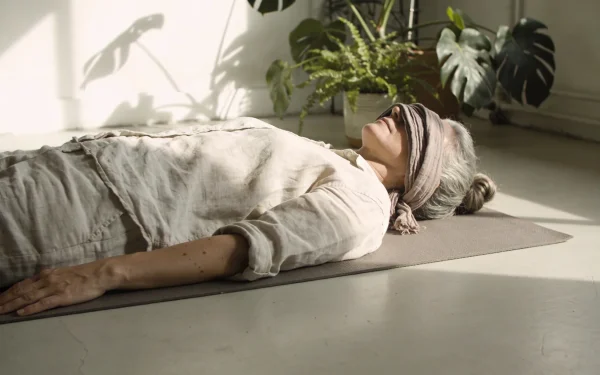
Lie down on a stable surface. Place your hands beside your hips, palms facing down. -
Containment (throughout)
Cover your eyes with a T-shirt or scarf, or keep them closed. Keep them covered or closed the entire session. -
Stillness (throughout)
Keep your body still. No swaying, rocking, stretching, or repositioning. -
Body location (1 minute)
Ask: “Where is the heaviest point right now?”
Choose one location only: throat, chest, stomach, jaw, shoulders. -
Tolerance (8 minutes)
Stay with that one location around 60–70% intensity.
If it spikes, widen your attention slightly around the area, then return.
No analysis. No storyline. Just sensation and contact. -
One quiet truth (1 minute)
Ask: “What truth is here if I stop arguing with it?”
Let one short sentence arrive. -
Integration (1 minute)
Write that sentence down. Drink water. Keep the next hour simple and low-input.
A common concern is, “What if I feel nothing?”
If nothing is obvious, stay with neutral data: weight of your hips on the floor, pressure at the back of your head, contact of your palms on the surface. Neutral contact is still contact. This matters because shutdown often softens in tiny increments, not dramatic breakthroughs.
Another concern is, “What if I get flooded?”
If intensity jumps too high, narrow the session to two minutes. Keep eyes covered or closed, body still, palms down. Choose one location and stay there briefly. Short, honest contact builds more trust than pushing past your capacity and crashing.
If you tend to abandon the practice when life gets busy, tie it to one existing moment: after brushing your teeth, after shutting your laptop, or before checking your phone in bed. The point is not creating a perfect routine. The point is teaching your body, again and again, that you return.
What changes after one honest session
Not a new you. Just a little less war inside the old one.
You may not feel dramatic relief. That is not the goal.
What often changes first is quieter and more durable: less internal fighting, faster recovery after activation, earlier recognition of freeze, and a small but real softening in chest pressure. The mind may still talk. The body feels less abandoned.
A lot of people expect healing to look like a clear upward line. In practice, it often looks like this: one hard day. One steadier day. One day where you catch the spiral earlier. One day where you still spiral but recover faster. That is progress. Capacity, not perfection.
You may also notice your relationships shift. Not because you become endlessly calm, but because you become more honest sooner. Instead of exploding after a week of suppression, you catch the jaw tension, the throat pressure, the chest constriction — and speak one sentence before shutdown takes over. This is where practice becomes life.
Another quiet sign of change: you stop needing every feeling to make sense before you allow it. You stop cross-examining your pain. You stop asking whether your grief is spiritual enough, valid enough, old enough, logical enough. You feel what is here. And that feeling begins to move.
This is where body-first healing spirituality becomes trustworthy. Not because every session feels profound, but because your system learns a new pattern: when pain appears, you return instead of performing.
Tomorrow, use a 30-second version in real life. In one ordinary stress moment, pause and reconnect with the same body location from tonight. No dramatic effort. Just contact. Repetition is what builds trust.
If you want more orientation without pressure, these can help:
– dark night of the soul spiritual crisis guide
– shadow work for beginners honest entry point
– examples of shadow work real life
Healing starts when your body believes you will not leave when pain appears. When that truth lands, spiritual work stops being a performance and becomes a relationship. Not a relationship with an ideal version of yourself — but with the part of you that tightens, shakes, goes numb, or goes quiet when life hurts. You do not need a better spiritual persona. You need repeated proof, in real moments, that you will stay. The more often you return, the less your system has to shout. The less it shouts, the more clearly you can hear what is true.
Real healing is this simple and this demanding: stay when it hurts, and let your body learn that you mean it.
You do not have to fight body-first healing spirituality by force, but you can meet it with honesty, gentleness, and one true next step.
When you’re ready, try Feeling.app free →
3 answers. 30 seconds each. No credit card. Yours to keep.
Frequently Asked Questions
Why do we sometimes feel worse after meditation instead of better?
Because stillness removes the lid that busyness was holding in place. If unresolved stress is stored in your body, silence may surface activation, numbness, or grief before any relief arrives. That usually means your practice needs body contact alongside the meditation — not that you are doing anything wrong.
How do we tell freeze response from actual calm?
Freeze tends to feel flat, heavy, and disconnected — even when you are functioning fine on the outside. Calm feels more alive, open, and connected to what is around you. If your “peace” includes bracing, numbness, or a sense of distance from yourself, freeze is worth exploring.
Can body-first healing spirituality replace therapy?
Sometimes it supports enough on its own. Sometimes it does not. Body-based spiritual practice can be powerful, but it is not a universal substitute for clinical care. If safety feels shaky or symptoms feel unmanageable, professional support is a wise next step.
What is the difference between somatic release and overwhelm?
Somatic release usually increases your capacity afterward: softer breath, clearer presence, steadier contact with yourself. Overwhelm reduces capacity and disconnects you from contact. If you feel flooded, shorten your sessions, lower the intensity, and rebuild gradually.
How often should we do the 12-minute practice?
Consistency matters more than intensity. A practical rhythm is 4–5 sessions per week, then adjust based on how your body responds in daily life. If activation rises, reduce duration and increase steadiness.
How long does trauma release usually take?
There is no universal timeline that is honest for everyone. What matters is repeatable, tolerable contact that builds trust over time. Smaller shifts that hold are usually more reliable than dramatic breakthroughs.
What is body-first healing spirituality?
Body-first healing spirituality is a body-level experience, not just a thought pattern. It often shows up as restlessness, jaw clenching, or a feeling of being stuck — your nervous system responding to something it hasn’t fully processed. It is not a flaw. It is protection that outlived its purpose.
What causes body-first healing spirituality?
The causes are rarely single events. Body-first healing spirituality typically builds from accumulated stress, relational patterns, unprocessed grief, or early environments where certain feelings were not safe to express. The body adapts, then the adaptation becomes the pattern.
A note on this work: The Feeling Session is a body-first emotional practice — not therapy, not medical care, and not a substitute for either. If you are in distress, dealing with severe symptoms, or unsure what you need, please reach out to a licensed mental-health professional. The information here reflects our lived experience guiding sessions; it is offered as support, not as diagnosis or treatment.
What are physical signs your body is releasing trauma?
By the body’s measure, it means a part of you has been carrying weight that hasn’t been allowed to be set down. The body has its own pace. The work is to stop interrupting it.
What are the 7 stages of healing?
By the body’s measure, it means a part of you has been carrying weight that hasn’t been allowed to be set down. Try one small thing today: lie down for ten minutes, palms beside your hips, eyes covered, body still. See what rises.